A useful quant roadmap has a shared core—mathematics, probability, programming and financial instruments—followed by a branch that matches the work you want to do. Learn through progressively harder calculations and projects, and assess progress by what you can explain, implement and challenge. There is no single course sequence or timetable that guarantees a quant job.
You can spend months gathering books without knowing whether your next hour belongs to probability, Python or option pricing. The way out is to identify your starting gaps and choose an output: a research experiment, a price-and-risk calculation, an execution analysis, or a reliable piece of software.
The sequence below helps you choose what to study now and what can wait. If you need an introduction to the field first, read quant finance for beginners.
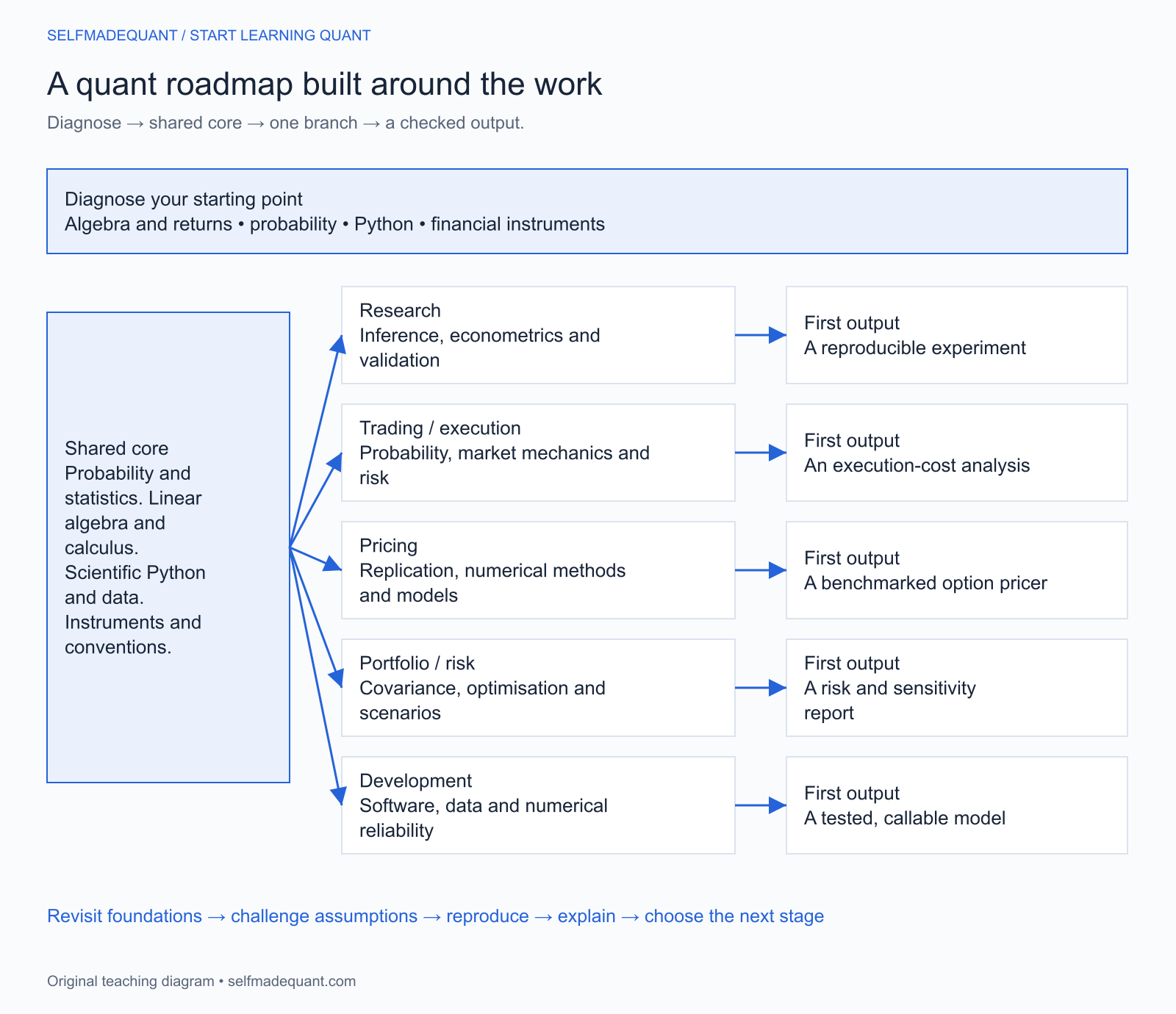
A quant self-study roadmap: diagnose your foundations, learn a shared core, choose one of five branches, then build and review a project.
Dependencies guide the sequence. Branches share subjects, and you can revisit foundations while building a project.
Step 1: diagnose your starting point
Try these without following a tutorial. An incomplete answer is information about where to begin.
Check
What you should be able to do
If you get stuck
Algebra and returns
Explain why a 10% loss followed by a 10% gain leaves wealth below its starting value
Keep a short learning log: task, attempt, error, repair and independent re-attempt. Rewatching a lecture is an activity. Solving a changed problem tells you whether the repair worked.
If you already have a quantitative degree, you may move quickly through some checks. If you are changing careers, you may need a longer foundation stage. Neither case justifies skipping the subjects that are new to you.
Step 2: build the shared core
Probability and statistics
Learn distributions, expectation, variance, dependence, conditional expectation, estimation and uncertainty. These are useful whether you are pricing a random payoff, evaluating a forecast or interpreting a risk estimate.
Use Probability, Statistics and Financial Data, with Harvard Stat 110 as an external probability course. A good checkpoint is explaining why conditioning changes the relevant distribution, then checking a small example by simulation.
Linear algebra, calculus and numerical methods
Learn vectors and matrices, differentiation and integration, linear systems, least squares and basic optimisation. Then learn why numerical procedures can be unstable even when the formula is correct.
Write functions, use arrays and tables, inspect dates and units, and reproduce a calculation from a clean start. Learn basic tests and source control alongside the numerical work.
After the primer, use Python for Quantitative Finance. A checkpoint is rebuilding a result from saved inputs and identifying which information was available at each observation time. The reproducibility lesson develops that habit.
Financial instruments and conventions
Understand equities, bonds, forwards, futures and options, plus discounting, collateral and trading mechanics. Small convention errors can dominate the difference between two sophisticated models.
First output: a simple strategy ledger. State when a signal becomes known, when the position can change, what costs apply and which benchmark answers the same question. Begin with point-in-time data.
Advance when: another person can reproduce your experiment, and you can explain at least one attractive result that weakened after a better test. A disappointing result can be evidence of useful research work.
First output: walk a hypothetical order through a specified order-book snapshot. Calculate its volume-weighted price, compare it with the midpoint and state which effects the static book excludes.
Advance when: you can explain how fills change inventory and why a quoted spread is not guaranteed profit. For interview preparation, inspect Jane Street's own interview guidance as one employer's example, then adapt your preparation to each role.
Derivatives pricing and model development
Prioritise calculus, probability, numerical methods and contract detail. Work through Options Pricing, beginning with replication in the binomial model. Add fixed income or more advanced derivatives when those instruments match your goal.
First output: price a European option using an analytic formula and a second method. Compare units, assumptions, numerical error and a sensitivity. The Monte Carlo pricing article shows why an estimate needs an error bar.
Advance when: you can investigate a disagreement instead of assuming one implementation is correct. Learn Brownian motion and Itô's lemma when continuous-time models enter the work.
Portfolio, risk and model validation
Prioritise covariance, optimisation, econometrics, instruments and written interpretation. Use Portfolio Management or Quantitative Risk Management, depending on your intended task. Independent validation adds model challenge and documentation; it is distinct from portfolio construction.
First output: calculate portfolio risk from a stated covariance matrix, then change the correlation or a constraint. Explain how much the result depends on the assumptions.
Advance when: you can write a decision memo describing the model, its limits, a challenger and a circumstance in which the result could mislead its user.
Quant development and research engineering
Prioritise programming, algorithms, data structures, numerical reliability and the domain your software serves. Start with scientific Python and testing numerical code. Add Professional Quant Practice.
First output: turn a notebook calculation into a small callable model with validated inputs, repeatable outputs and tests. Someone else should be able to run it without editing your personal file paths.
Advance when: you can diagnose failures, measure a bottleneck and explain a design choice. Python is enough to begin this route; particular engineering roles can require other languages and deeper systems knowledge. Let the vacancy and project determine what comes next.
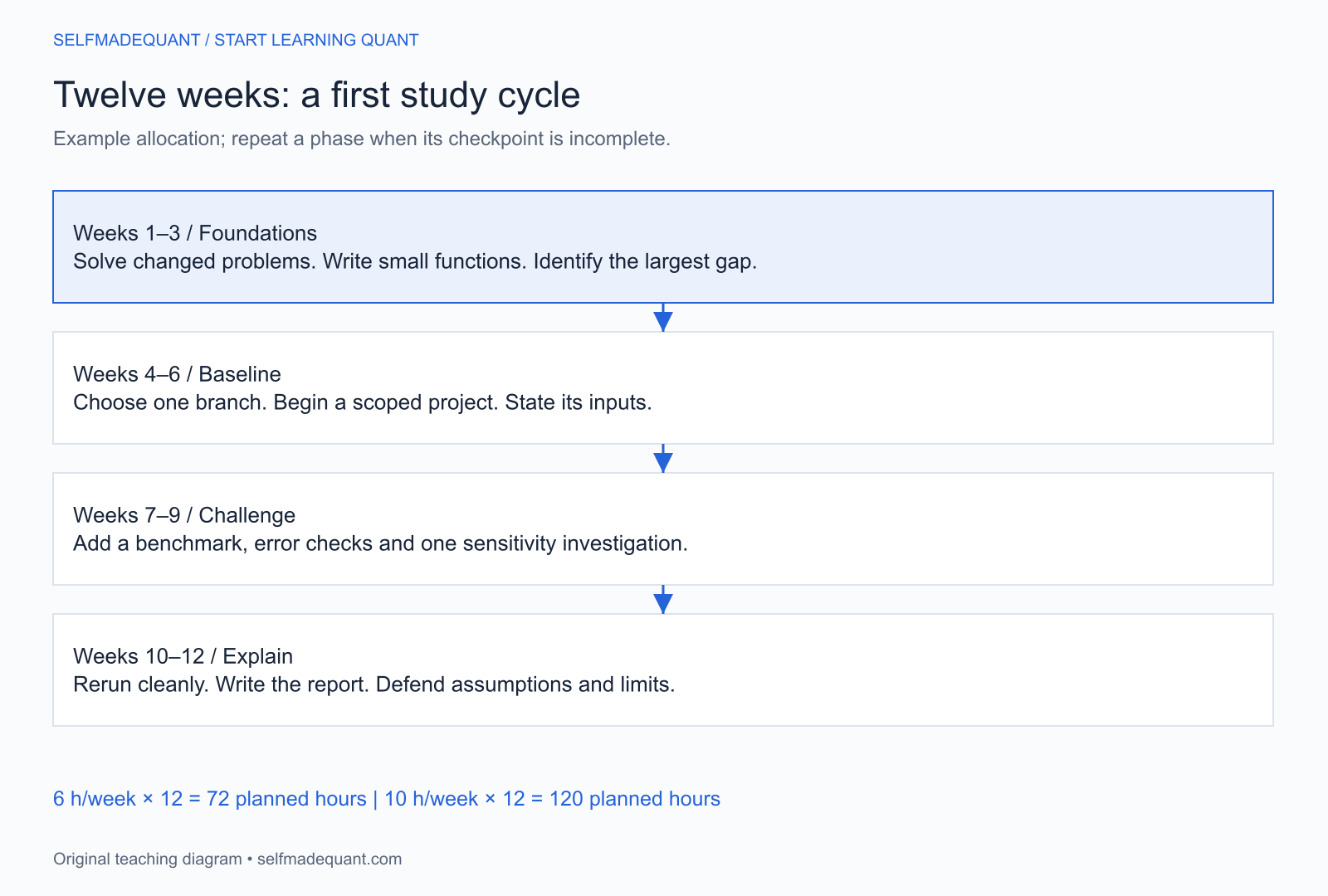
Here is an illustrative twelve-week cycle for someone who can devote a regular block of time each week. It is a planning template, not a prediction of how long you need to become employable.
Phase
Focus
Evidence at the end
Weeks 1–3
Repair the largest foundation gaps
Independently solved problems and short functions
Weeks 4–6
Study one branch and begin a small project
A working baseline with stated inputs
Weeks 7–9
Challenge the project
Error checks, a benchmark and one sensitivity
Weeks 10–12
Reproduce, write and explain
A clean rerun, report and oral explanation
A twelve-week study cycle with outputs: foundation checks, one project baseline, independent challenges and a reproducible report.
Example allocation. Extend or repeat a phase when its checkpoint is incomplete.
At six hours per week, twelve weeks gives you 72 planned hours. At ten hours it gives you 120. These are arithmetic budgets, not measured completion times for a programme. Include debugging, exercises and writing rather than allocating every hour to videos.
If a foundation gap prevents the project from progressing, repair that dependency. If the project is working, resist expanding its scope before you can reproduce the original result.
Step 5: prepare for applications alongside learning
Read a small sample of relevant vacancies and record recurring requirements. Separate explicit academic or experience requirements from skills you can demonstrate through projects. Do not assume that a course certificate substitutes for a required degree or professional experience.
Practise explaining assumptions, solving unfamiliar problems and responding to a changed question. Use SelfMadeQuant interview preparation to connect practice with the subjects you are studying. The interview-question overview helps distinguish probability, coding, statistics and domain questions.
For a project, prepare a five-minute account: question, data, method, strongest check, main limitation and next experiment. Be ready to discuss the result that failed. A polished chart without a defensible experiment gives an interviewer little to assess.
Questions about the roadmap
Can I follow this without a finance degree?
Yes, the learning sequence is usable from different educational backgrounds. Employment eligibility is a separate question. Read quant without a finance degree for examples of employer requirements and a way to identify your own gaps.
Should I finish all the maths before starting Python?
No. Learn enough maths to understand a small problem and enough Python to investigate it. Return to the mathematical foundation when you cannot explain the result. A project should expose gaps rather than conceal them behind a library call.
What is the best first quant project?
Choose a calculation with a benchmark: a return ledger, portfolio-risk calculation, option pricer or static execution-cost analysis. The project guide connects larger choices to role families. The best first project is one whose inputs, outputs and failure cases you can explain.
Put the roadmap to work
Open the SelfMadeQuant curriculum, choose the programme that addresses your largest current gap, and pair it with one output from your chosen branch. Keep the scope small enough to finish, check and discuss. Your next study decision should follow from the evidence in that work.
Download the accompanying Python examples
Get the series code package. The download contains four runnable beginner examples, an editable notebook and generators for the compounding, portfolio-correlation and Monte Carlo charts. Start with the unchanged examples, then alter one assumption and explain the result. Downloads use the app’s usual email or member access.
Go deeper with lessons, derivations and worked exercises behind this article.