Can you become a quant without a finance degree? Routes, requirements and gaps
Yes, a finance degree is not a universal requirement for quant work. Quantitative education, programming, research experience and problem-solving can be more relevant to particular roles. However, “without a finance degree” is different from “without a degree,” and employers can impose specific academic or experience requirements. Start by identifying the role and checking its current criteria.
Someone with a physics degree and experience analysing noisy measurements faces different gaps from someone new to both mathematics and programming. A software engineer may bring strong implementation skills while needing probability and market knowledge. A finance graduate may understand instruments while needing more statistics or code.
What employer sources actually say
| Primary employer source | What it says about preparation | What you can reasonably infer |
|---|---|---|
| Citadel: Quantitative Research Analyst, University Graduate, US | Lists a bachelor's or master's degree in a highly quantitative field, alongside probability, statistics, research and coding | A finance major is not the only route; the role still has academic requirements |
| Citadel: Quantitative Researcher, Data Strategies Group | Lists quantitative degrees and substantial statistical, modelling and programming capabilities | Subject label alone is insufficient; the work requires relevant technical depth |
| Jane Street: London trading internship | Says no specific degree or major is required and emphasises quantitative thinking | This particular opportunity does not prescribe a finance degree; it does not establish an industry-wide rule |
| Jane Street: interview guidance | Describes role-specific problem solving and says its trading interviews do not test prior finance or economics knowledge | Distinguish an employer's interview scope from all the knowledge used in the eventual job |
The repeated lesson is to read the actual criteria. “Quant requires a finance degree” is too broad. “Degrees never matter because one firm is flexible” is also too broad.
Check the live employer page again when applying. Requirements can differ by geography, seniority, programme and team, and an application can involve conditions beyond academic preparation.
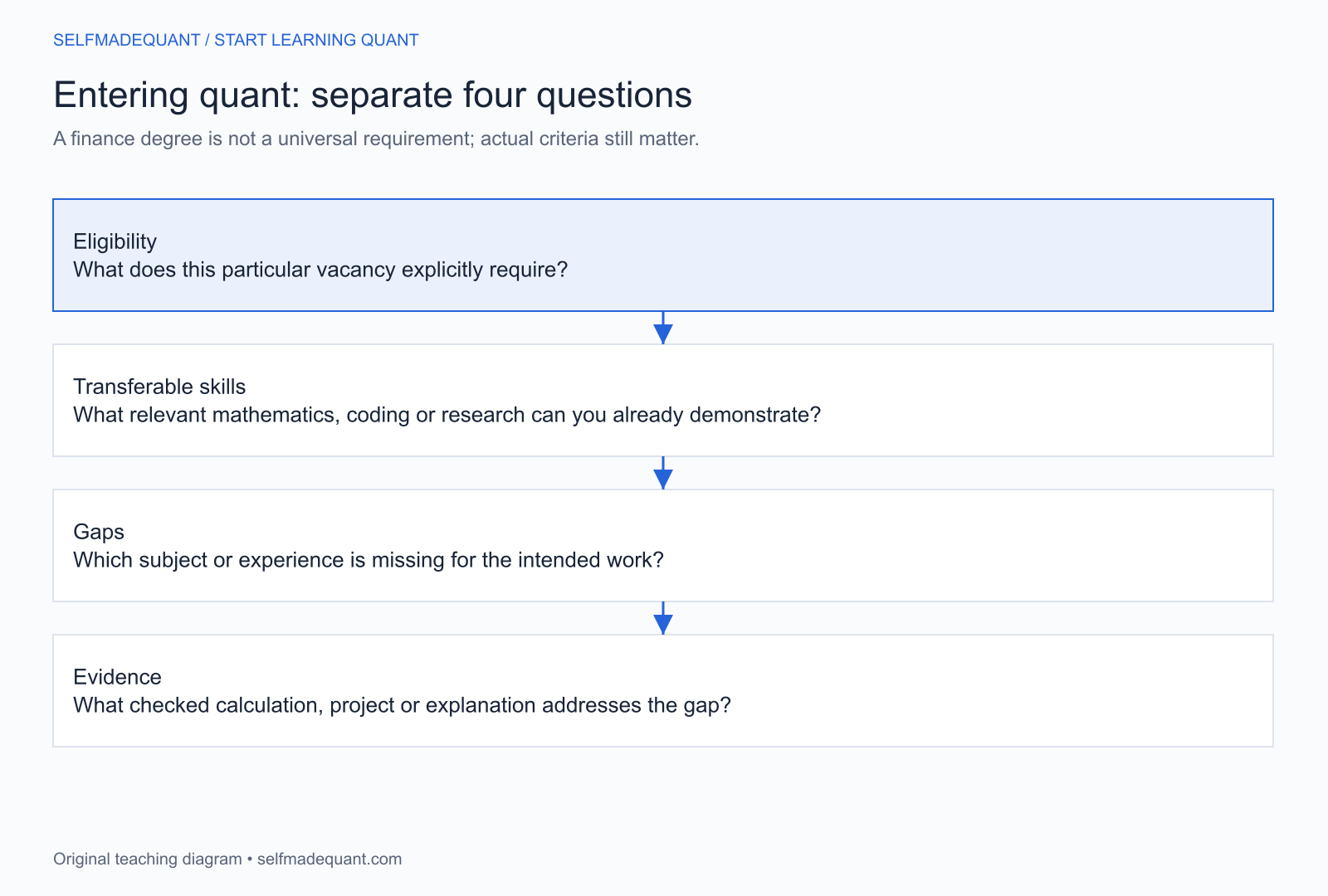
Separate three different questions
1. Do you satisfy the role's explicit criteria?
Record the specified education, experience, location and other application conditions. Separate a requirement from a preference where the employer does so. If wording is unclear, seek clarification through the employer's stated recruitment process rather than assuming an exception.
A self-study programme can improve skills. It cannot grant a university degree or change a vacancy's formal conditions. That distinction helps you choose realistic applications and decide whether additional formal education deserves consideration.
2. Can you perform the relevant technical tasks?
This includes solving unfamiliar problems, writing code, handling data and explaining assumptions. You may have these skills from another field, or you may need substantial new study.
Someone with research experience should still learn how financial data differ from a controlled experiment. Someone with production software experience should still learn what the model calculates and how its numerical behaviour is checked.
3. Can another person assess your evidence?
A project needs enough documentation, inputs and checks for someone else to understand it. A repository containing only a notebook and a performance chart may hide the very choices an evaluator needs to inspect.
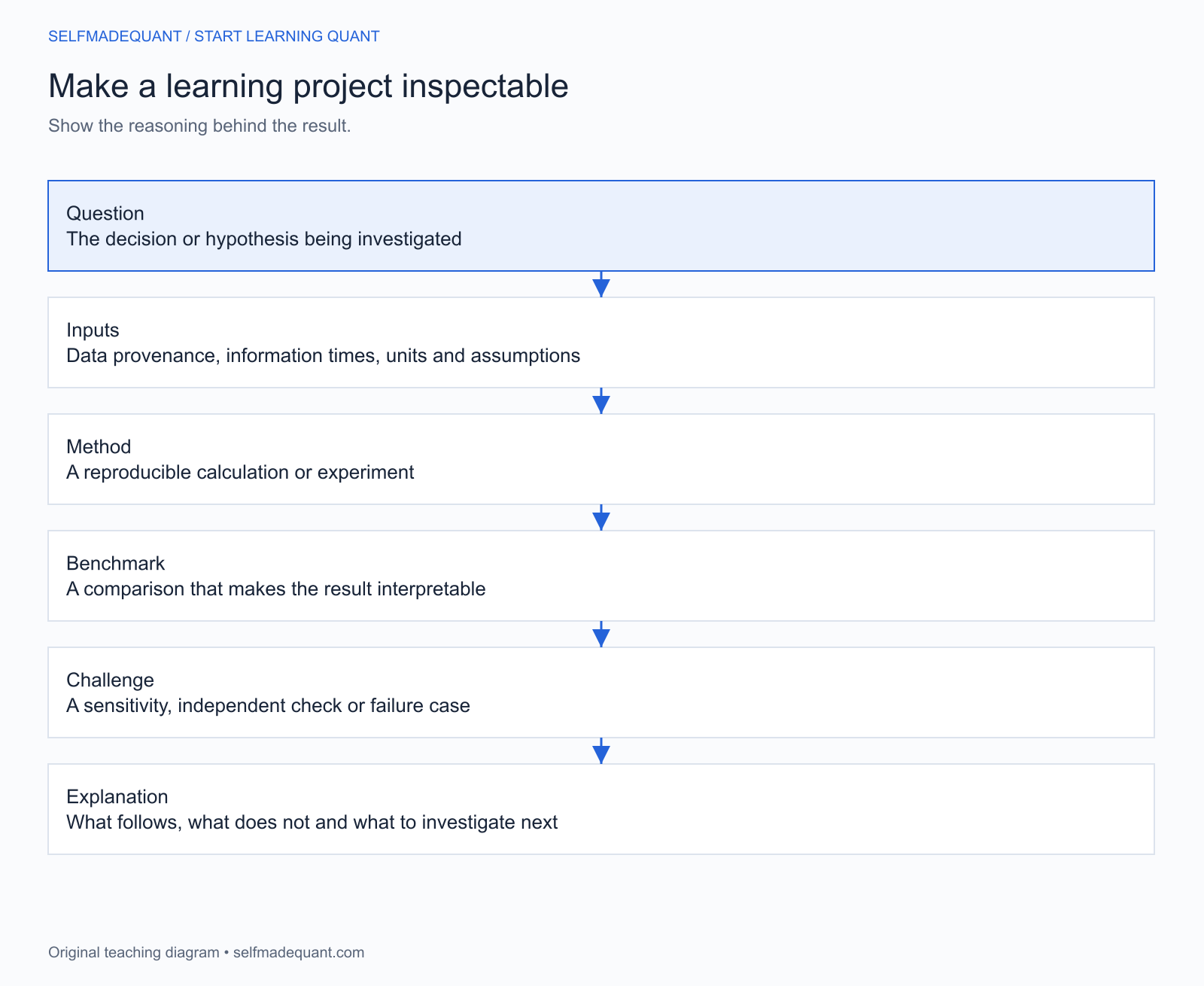
Write a concise report explaining the question, method, benchmark, strongest check and limitation. Be prepared to answer a follow-up that changes an assumption.
A gap map for common starting backgrounds
These are illustrative starting points, not claims about every degree or person.
| Background | Skills you may already bring | Gaps to investigate first | A small test project |
|---|---|---|---|
| Mathematics or physics | Modelling, proof, calculus or numerical work | Financial instruments, data timing and empirical validation | A checked option pricer or point-in-time experiment |
| Computer science or software engineering | Algorithms, software design and debugging | Probability, statistics and financial interpretation | Package a risk calculation with numerical benchmarks |
| Economics or econometrics | Regression, economic reasoning and data analysis | Software reliability, instrument conventions or deeper probability | A forecast comparison with time-ordered validation |
| Finance or business | Markets, accounting or instrument knowledge | Mathematical depth, coding or research design | A return ledger and covariance calculation |
| No quantitative study yet | Experience that depends on your work and education | Algebra, probability and programming foundations | The beginner return calculator before a strategy project |
Use tasks to test these assumptions. A degree title does not establish the depth of every subject within it, and a career label does not fully describe someone's capabilities.
Choose a role before choosing a credential
What self-study can and cannot provide
Self-study can develop concepts, technical habits and inspectable work. University study can also provide formal assessment, academic depth, supervision and access to opportunities. The importance of each depends on your starting point and target role.
When considering an online course or degree, compare prerequisites, curriculum, assessed work, feedback, credential and total commitment. A course with a familiar title may be introductory, while another assumes advanced mathematics. A completion certificate is not automatically an accredited academic qualification.
The following resources can help you test a subject before making a larger commitment:
- MIT OpenCourseWare linear algebra for a substantial matrix-methods foundation.
- Harvard Stat 110 for probability, practice and links to lecture videos.
- Harvard CS50P for programming fundamentals and problem sets.
- MIT Finance Theory I for a university finance course's subject structure.
- QuantEcon's first Python course for numerical and economic modelling examples.
Use the provider's current page to understand access and certificate arrangements. The linked teaching materials are useful learning resources; listing them here does not imply a partnership or admission pathway.
Build evidence that is easy to inspect
Choose a project whose result you can check. For example, investigate how correlation changes portfolio risk, compare a numerical price with an analytic benchmark, or examine the effect of repairing an information-timing error.
Your report should answer six questions:
- What decision or hypothesis did you investigate?
- What information and model assumptions did you use?
- Which benchmark makes the result interpretable?
- What independent check did you perform?
- What failed or remained uncertain?
- What would you investigate next?
Avoid making a profitability claim from one attractive backtest. A project is stronger when it explains data limitations and failure modes than when it hides them behind a headline return.
Prepare for the missing part of the application
If you are strong at coding but weak at probability, allocate practice time to probability. If you solve written problems well but struggle to explain your work, practise discussing a changed assumption out loud.
If your target positions consistently require education or experience you do not have, reassess the route. That could mean additional study, a different entry point or a role that better matches your current strengths. It should be a decision based on real requirements rather than a generic promise about breaking into finance.
Frequently asked questions
Can I become a quant without any degree?
Some opportunities do not prescribe a particular degree, while others explicitly require one. The employer examples above do not establish a general probability of success without a degree. Check specific criteria and build relevant evidence; do not treat a flexible requirement at one firm as universal.
Do I need a PhD?
Not for every role. Some research positions value or require advanced research training; other positions accept different qualifications. Compare the current vacancy with your background instead of assuming a rule from the word “quant.”
Can I teach myself the finance?
Will a portfolio of projects replace experience?
Projects can demonstrate skills and support a discussion, but they do not automatically substitute for a stated professional-experience requirement. Present them as evidence of what you did and learned, with a clear scope and limitations.
Make your next step specific
Download the accompanying Python examples
Go deeper with lessons, derivations and worked exercises behind this article.