What is market making? A quoting game in five stages
Suppose I offer you a contract that pays the result of a fair six-sided die, in dollars.
If the die lands on 1, the contract pays $1. If it lands on 6, it pays $6.
Before we see the result, tell me your buying price and your selling price. Also tell me how many contracts you will trade at each price.
What would you quote?
That decision gives us a small version of a market-making problem. You quote prices for someone else to trade. Then you manage the position created by those trades.
Let’s work through five stages. We will keep the same simple contract and change one part of the game at a time.
Stage one: What is the contract worth?
Here, is the amount the contract eventually pays. Under our assumptions, $3.50 is a useful starting estimate of value.
Suppose you quote:
| Your quote | What you agree to do |
|---|---|
| Bid: $3 | Buy one contract for $3 |
| Ask: $4 | Sell one contract for $4 |
Your quote midpoint is $3.50. It equals our expected payoff because we chose a symmetric quote around that estimate. A quote midpoint does not automatically equal an instrument’s true value.
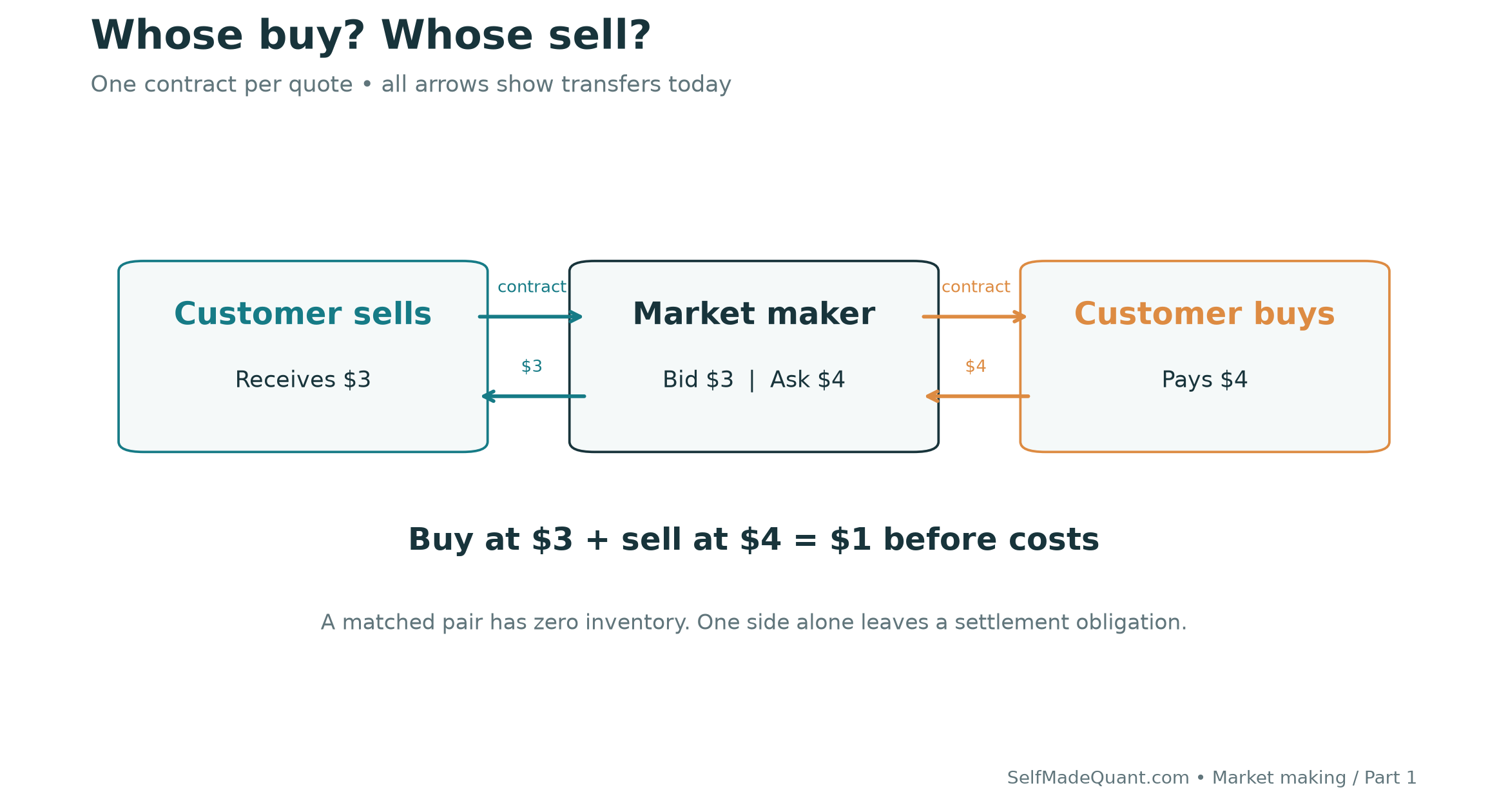
If I buy from you, I pay your ask of $4. If I sell to you, I receive your bid of $3.
Why offer both prices? A customer may want to trade now. They may not want to wait for another customer to take the opposite side. A market maker agrees to buy or sell up to the quoted size.
Size matters. A quote for one contract commits you to much less exposure than the same prices for 100 contracts.
Stage two: How do you make money—and how can you lose it?
Suppose I buy one contract from you for $4. You receive $4 today, but owe the settlement payoff later.
Your profit is:
| Die result | Cash received | Settlement paid | Your profit |
|---|---|---|---|
| 1 | $4 | $1 | +$3 |
| 2 | $4 | $2 | +$2 |
| 3 | $4 | $3 | +$1 |
| 4 | $4 | $4 | $0 |
| 5 | $4 | $5 | −$1 |
| 6 | $4 | $6 | −$2 |
If my decision to buy contains no information about the die result, your expected profit is:
Your expected profit is positive. You still lose money on two of the six possible outcomes.
Now suppose someone sells you a contract at $3 and another person buys an identical contract from you at $4, both before settlement in the same round.
Your net position is zero. The settlement obligations cancel, and you keep $1 before costs.
That matched pair explains “buy at the bid, sell at the ask”. You need both trades to earn that spread. You may sell a contract and wait for a purchase that offsets it. Or several customers may all trade on the same side.
So the displayed spread is not the profit from every trade. To calculate profit, track the position you hold, later price changes, and fees. Also ask what each trade tells you about value.
Stage three: What if everyone sells to you?
Suppose you keep renewing your bid and five people each sell you one contract for $3.
Since all five contracts pay the same result, your settlement profit is:
If the die lands on 1, you receive $5 and lose $10. If it lands on 6, you receive $30 and make $15.
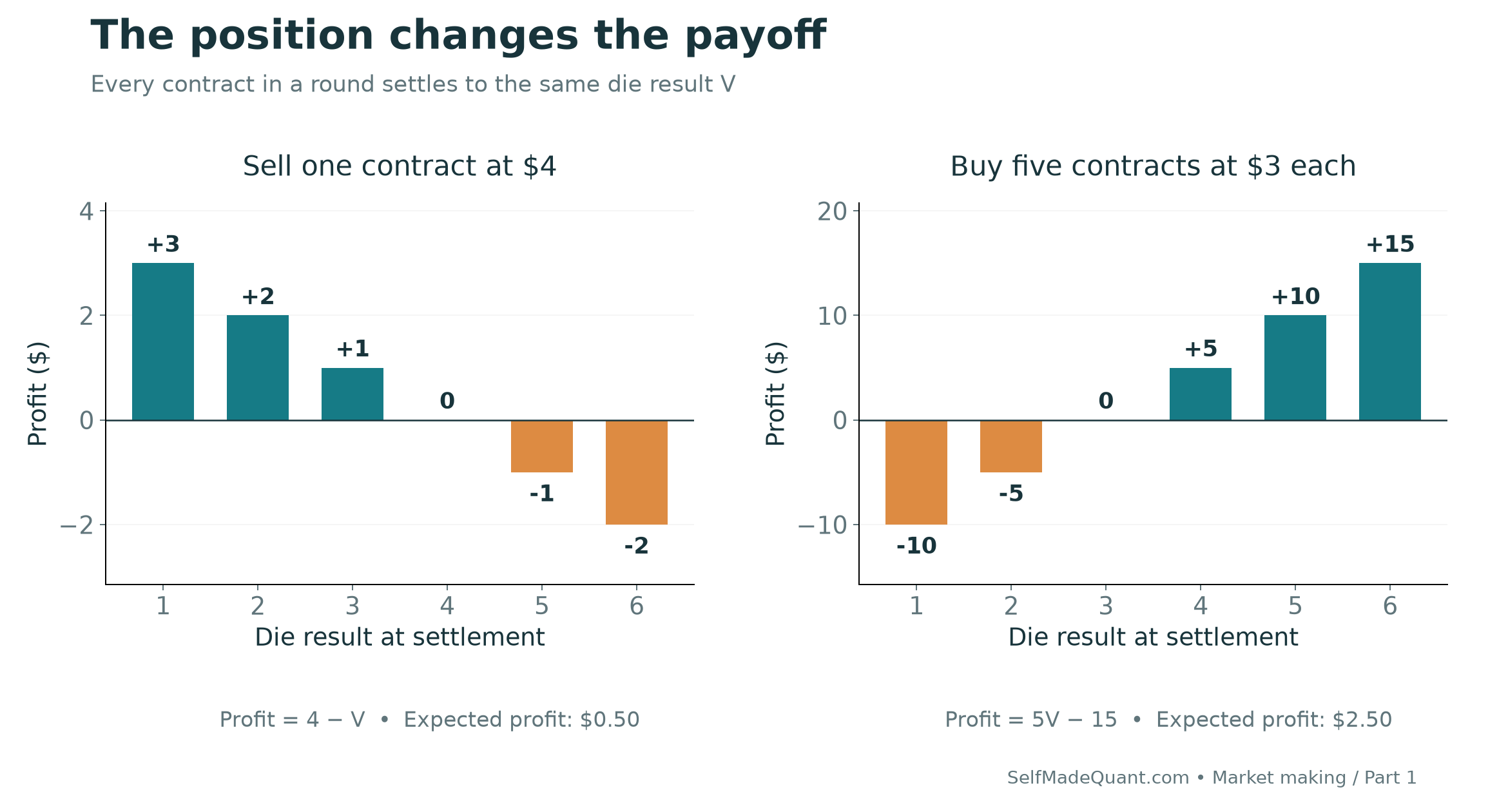
You quoted these prices earlier. Now you hold five contracts, so you carry more exposure.
Would you keep quoting $3/$4 for the same size?
One possible adjustment is to lower both prices. For illustration, try a bid of $2.50 and an ask of $3.50:
- Your lower bid makes selling to you less attractive.
- Your lower ask makes buying from you more attractive.
- Both changes can help reduce a long inventory if customers respond to price.
You could also reduce bid size or offer more contracts for sale. These prices illustrate the adjustment. To choose a policy, you need a model of risk and customer behaviour.
Separate your value estimate from your inventory decision. Your estimate of the contract’s expected payoff may still be $3.50, while your willingness to buy another contract has changed because you already own five.
Stage four: What if the other trader knows more than you?
Reset the game. You have no inventory and quote $3/$4 again.
This time, someone has rolled the die privately. The other trader sees the result. You do not.
Assume they trade only when doing so gives them a strictly positive profit.
| Result they see | Their decision | Your profit |
|---|---|---|
| 1 | Sell to your $3 bid | −$2 |
| 2 | Sell to your $3 bid | −$1 |
| 3 | Do not trade | $0 |
| 4 | Do not trade | $0 |
| 5 | Buy at your $4 ask | −$1 |
| 6 | Buy at your $4 ask | −$2 |
You lose on every trade that occurs. Across the four equally likely trading outcomes, the average loss is $1.50 per filled contract.
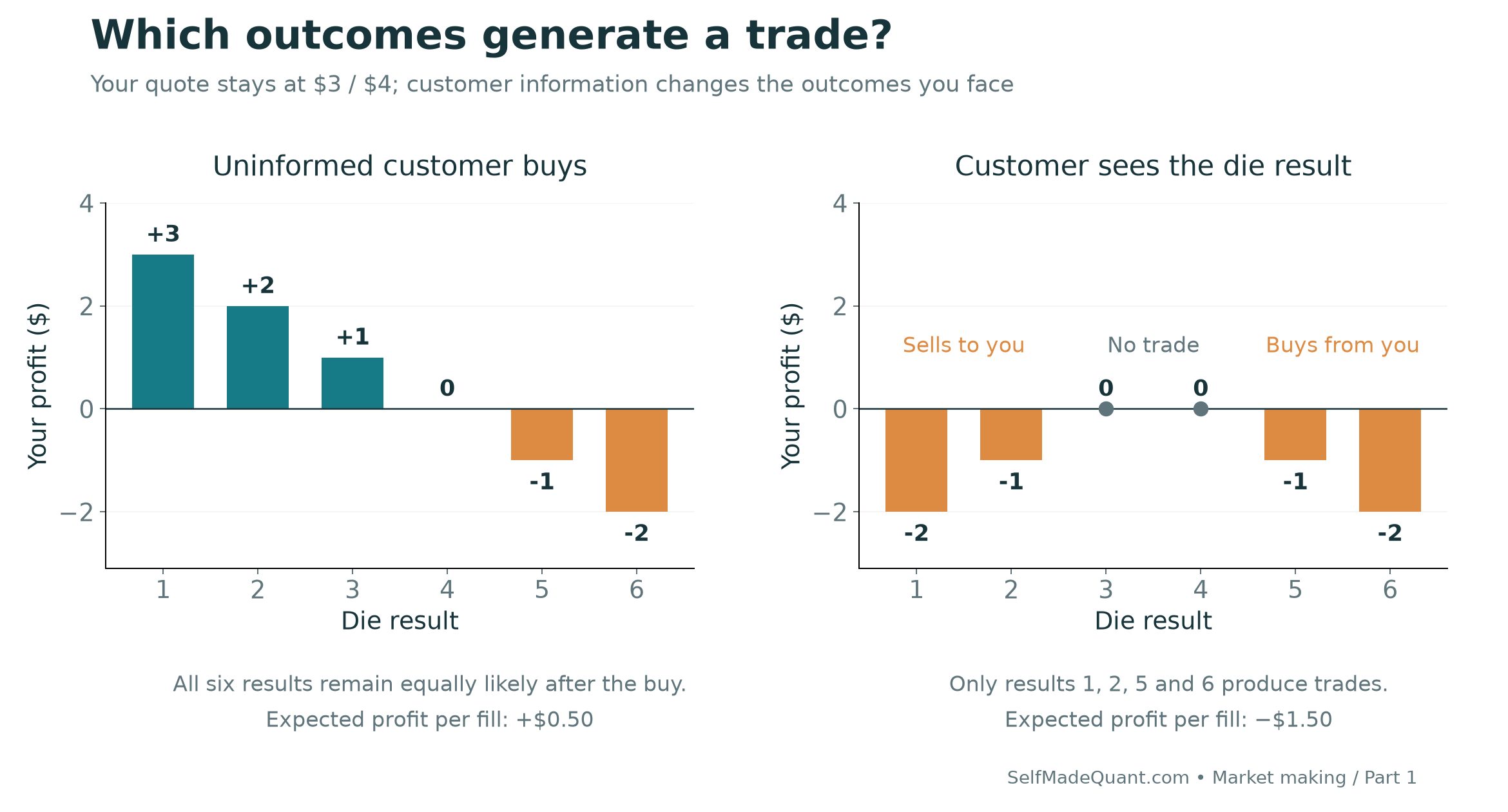
The contract still has an unconditional expected payoff of $3.50. But once this person buys from you, the relevant possible results are 5 and 6. Their conditional average is $5.50.
You sold at $4 to a customer whose decision signals a conditional value of $5.50.
Real customers rarely know a final payoff with certainty. They may have partial information, a faster view of another market, or a better forecast. Others trade because they need liquidity. Ask what customers know and why they trade. You usually cannot observe either directly.
Public information also changes the calculation. Suppose everyone learns that our die result is even. The possible values are now 2, 4, and 6, so:
Your reference value has moved from $3.50 to $4. A quote based on the old information may no longer suit the game.
Who is on the other side of your quote?
So far, the other trader either knows nothing about the result or has seen it. Real customers have different information and different reasons to trade.
Consider six useful roles:
| Participant | What motivates the trade? | What it means for your quote |
|---|---|---|
| Informed trader | A belief about value supported by information or analysis you have not fully incorporated | Their decision to trade can signal that your price is stale or your estimate needs updating. |
| Noise trader | A decision that the model treats as unrelated to information about the payoff | Their trades can offer an expected price edge while still leaving you with inventory risk. |
| Liquidity-motivated trader | A need to invest, raise cash, or rebalance | They may accept a cost for immediacy; their order can be large or persistent. |
| Hedger | A need to reduce exposure elsewhere in their portfolio or business | Their trade can be driven by risk management, with urgency and size affecting execution. |
| Arbitrageur | A price discrepancy between related instruments or venues | They can trade against a quote that has fallen out of line with other available prices. |
| Another market maker | A need to provide liquidity, compete for flow, or adjust inventory | They can compete with your quote or trade against it to manage their own position. |
These roles can overlap. A market maker can hedge through another dealer, and an investor with a liquidity need can also have useful information. A broker or execution algorithm may send the order. The investor behind it determines why the trade occurs.
Stage five: Why not quote a very wide spread?
If trading with informed customers is dangerous, why not buy at $1 and sell at $6?
Introduce a second dealer. You quote $3/$4. They quote $3.25/$3.75, for the same size and on the same terms.
A customer who wants to sell gets a higher price from them. A customer who wants to buy pays a lower price to them.
Under the simplified rule that customers choose the best available price, your competitor receives those trades.
A wider spread may increase the margin on each trade. It can also reduce the number of trades you receive. A tighter spread may attract more trades, but each leaves less margin for costs and adverse price moves.
Choose the quote centre, spread, and size. Also decide how much inventory you are willing to carry.
The right choice depends on information, customer behaviour, risk, and competition. There is no universal spread that solves every market-making problem.
From the game to a market
Our contract has a simple payoff and one reveal. Real markets have changing order books, several venues, different allocation rules, fees, and orders that take time to arrive or cancel.
A displayed price also does not guarantee that your order will trade. Other orders may have priority at the same price. If 500 shares are ahead of you and an incoming order trades only 100, your order can remain unfilled.
That makes market making a continuing sequence of decisions. First, estimate value and quote prices and size. Then observe trades and new information. Manage the resulting exposure and choose your next quote.
Before moving on, try the one-die game with a friend. Record each quote, each trade, your cash, and your inventory. Then settle the contracts. Explain the result in three parts: your quoted prices, the position you held, and the other person’s information.
Until then, peace.
Go deeper with lessons, derivations and worked exercises behind this article.