Quant interview questions can test probability, expected value, statistics, programming, market reasoning and your ability to defend a project. A useful answer defines the experiment, states assumptions, solves the problem and checks the result. The emphasis differs by role and employer; a question list is a starting point for practice rather than a universal interview syllabus.
This guide gives you six worked entry questions and routes into deeper problem sets. Attempt each question before reading its solution. The examples are original teaching exercises or independently explained classical probability setups, not claims about questions asked by a particular firm.
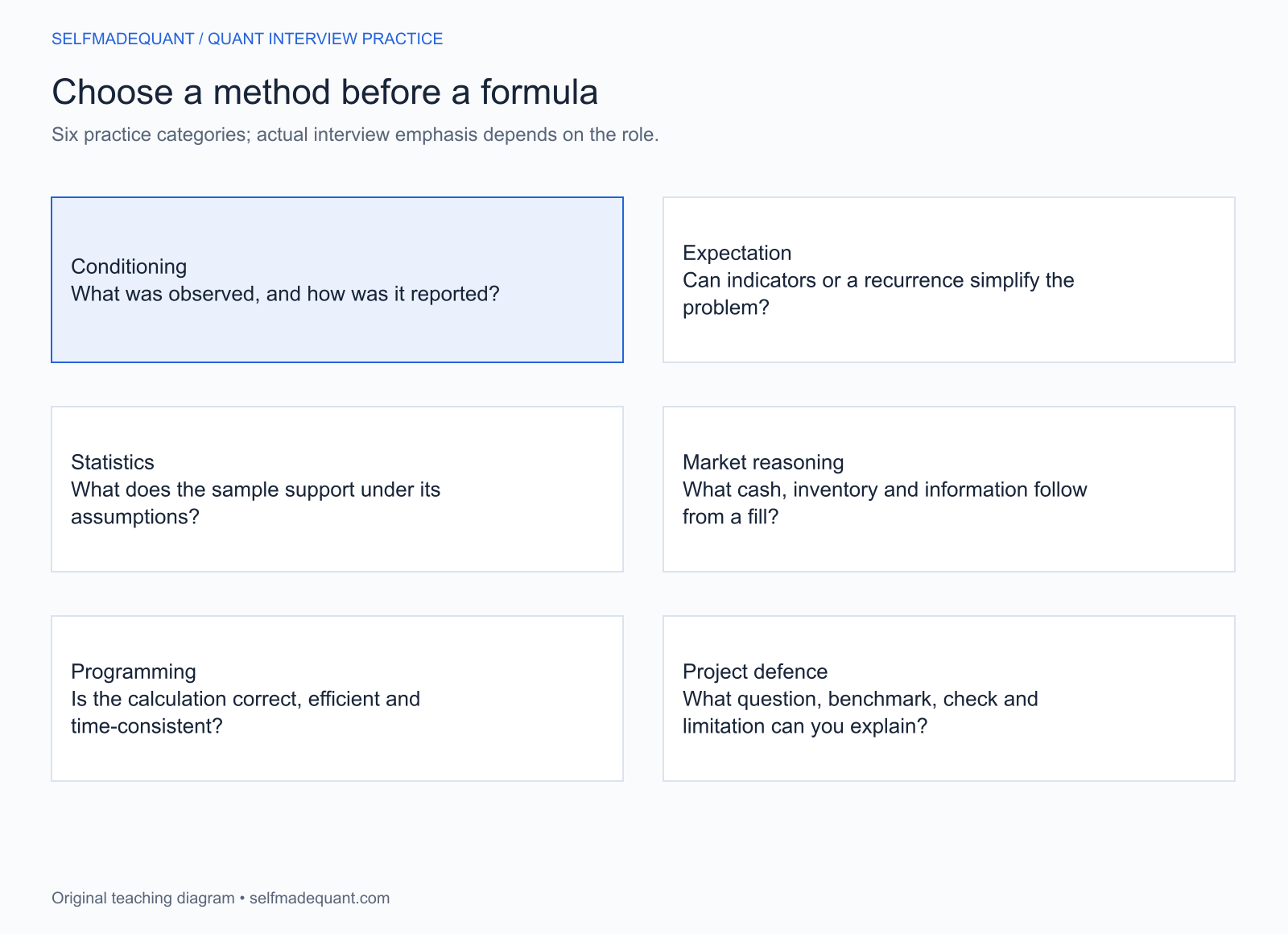
A map of quant interview practice: probability, expectation, statistics, market reasoning, programming and project defence connect to different kinds of evidence.
Study priorities depend on the actual role. The map describes practice categories, not the frequency of questions in employers' interviews.
Start with the question behind the question
An interviewer may change the observation, introduce a cost, ask for an efficient implementation or challenge a statistical assumption. A memorised number does little work after that change.
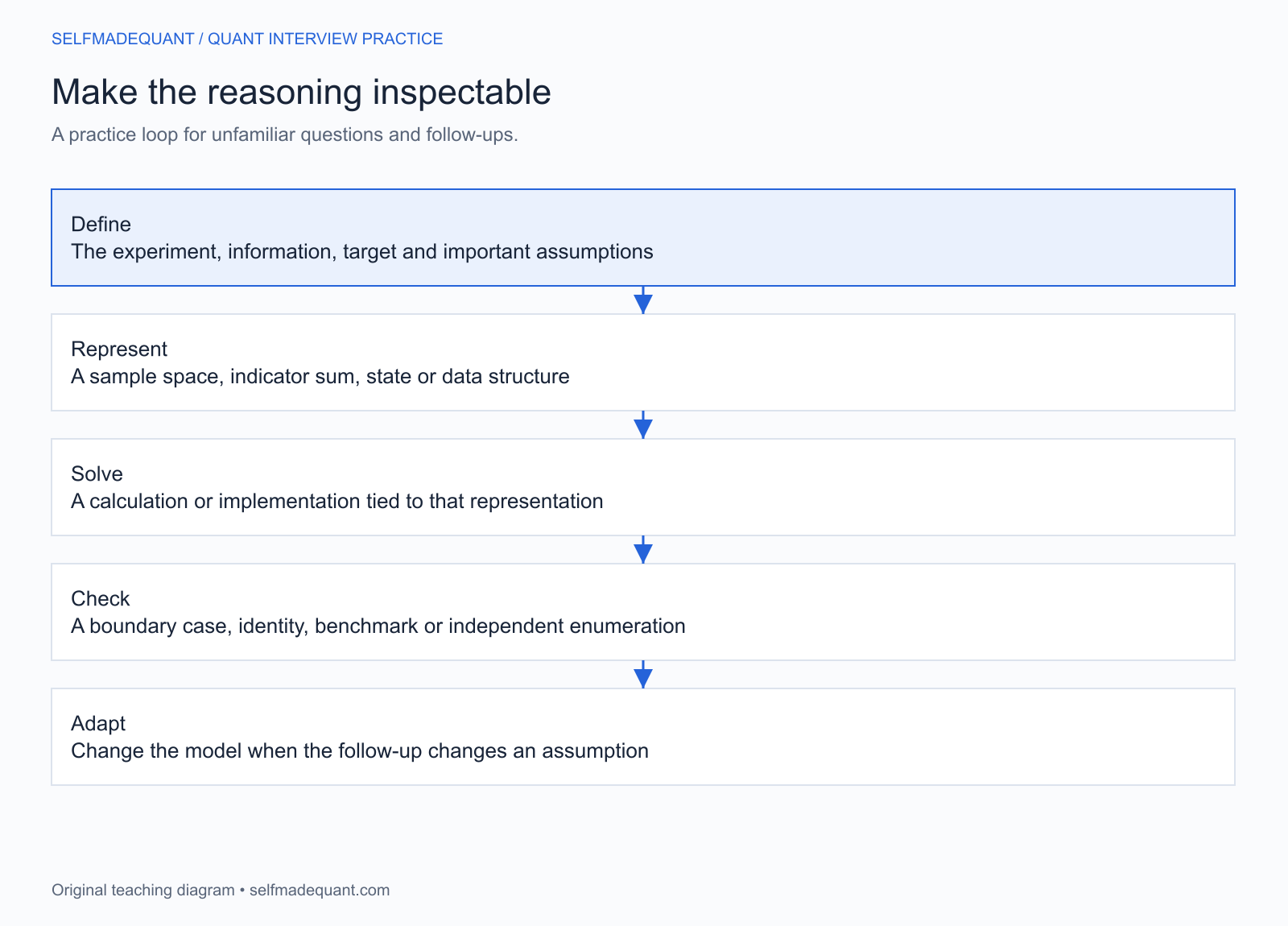
Use four moves: define what is random or given; select a representation; calculate; check what changes under a follow-up. You can make these moves without narrating every thought. State the decisive assumptions and reasoning steps clearly.
Jane Street's interview guidance describes different preparation for trading, research and technology. Its trading interview page and mock interview provide one employer's example of collaborative problem solving. Use employer material to tailor your preparation, rather than assuming every firm uses the same process.
Question 1: conditional probability
Question. A card is drawn uniformly from a standard 52-card deck. You are told it is a jack, queen or king. What is the probability it is a king?
Hint. Describe the outcomes remaining after the information, not all 52 original outcomes.
Solution. There are four jacks, four queens and four kings, so 12 equally likely cards satisfy the observation. Four are kings. The conditional probability is 4/12=1/3.
The original probability of a king, 4/52, is not the answer after conditioning. The observation changes the relevant denominator.
Common mistake. Counting three possible ranks correctly but forgetting to justify why they have equal conditional probabilities. Here they do because each rank has four cards and the original draw is uniform.
Follow-up. What if the information is that the card is a red face card? Six cards remain and two are kings, so the answer is still 1/3. The number happens to agree; the conditioning event is different.
Question. Roll two fair independent six-sided dice. What is the expected sum? Does linearity of expectation require independence?
Solution. Each die has expectation (1+2+3+4+5+6)/6=3.5. The expected sum is 7. Linearity does not require independence, provided the expectations exist. Fair marginal distributions are enough for this expected sum.
Independence matters for other quantities. If the second die were always equal to the first, the sum would still have expectation 7, but its variance would differ from the independent case.
Common mistake. Treating a condition needed for a variance calculation as a condition needed for an expected-value calculation.
Follow-up. For independent dice, each has variance 35/12, so the sum has variance 35/6. If both always show the same fair outcome, the sum equals twice one die and has variance 35/3.
Question. You average nine independent observations drawn from a distribution with standard deviation 6. What is the standard deviation of their average?
Solution. Independence makes the variance of the sum 9×62. Dividing the sum by nine divides its variance by 92. The average therefore has standard deviation 6/9=2.
This is the standard error of the sample mean under the stated model. The observations themselves still have standard deviation 6. Averaging reduces uncertainty in the estimated mean, not the dispersion of the underlying observations.
Common mistake. Dividing standard deviation by sample size instead of its square root, or applying the independent-sample expression to dependent observations without checking it.
Follow-up. If all nine observations are identical copies of the same random draw, averaging them supplies no extra information. The average is that draw and still has standard deviation 6.
Question. A portfolio holds 80% in an asset with annual model volatility 10% and 20% in an asset with annual model volatility 20%. Their correlation is zero. What is portfolio volatility under this covariance model?
Solution. With no covariance term, model variance is:
0.82(0.10)2+0.22(0.20)2=0.008.
The square root is approximately 8.94% per year. This is a model calculation, not a guaranteed future risk level.
Common mistake. Taking the weighted average of volatilities. With correlation 1, that would give 12%, but zero correlation is the stated case.
Follow-up. With correlation 1, include the covariance terms. Variance becomes (0.8×0.10+0.2×0.20)2, so model volatility is 12%.
Question. A contract pays 0 or 10 with equal probability. Ignore discounting, costs and counterparty risk. You quote a bid of 4 and an ask of 6 for one contract. If a customer's decision to buy contains no information about the payoff, what is your expected profit when they buy from you?
Solution. The customer pays your ask of 6. You owe the eventual payoff, whose expectation is 5. Expected profit is 6−5=1. Realised profit is either 6 or −4.
Common mistake. Calling the bid–ask spread of 2 the profit on this single sale. Earning the cash difference between an offsetting buy and sale is a different transaction sequence.
Follow-up. If a buy indicates the high payoff with conditional probability 80%, expected settlement is 8 and your expected profit at the same ask becomes −2. The relevant value is conditional on the trade you actually receive.
Question. An asset price moves from 100 to 110, then to 99. A function adds the two simple returns and reports a total return of zero. What is wrong?
Solution. The returns are +10% and −10%, but they apply to different bases. The compounded wealth factor is 1.10×0.90=0.99, giving a total return of −1%. The ratio of final to initial price independently confirms 99/100−1=−1%.
Common mistake. Debugging only the loop or data type while leaving the financial equation unchanged. Correctly implemented addition still calculates the wrong quantity here.
Follow-up. For positive prices, log returns add exactly across periods. Their sum is the log of the final-to-initial price ratio. Convert back with the exponential before reporting the simple total return.
If asked about a project, explain its question, inputs, benchmark, strongest check and limitation. “I trained a model and obtained a high score” leaves the evaluation design unresolved.
For a financial forecast, say what was known at each decision, how training and evaluation were separated, and what changed after costs or a better baseline. For a numerical model, identify the contract, assumptions, convergence evidence and an independent reference calculation.
Use point-in-time data and time-ordered validation to make that explanation concrete. A result that failed can support a good technical discussion when you understand why it failed.
A worked-answer loop: define the experiment, represent the problem, solve, check and respond to a changed assumption.
Practise the reasoning moves, then apply them to an unfamiliar question.
How to choose what to practise next
If you missed the denominator in question 1, study conditioning. If you understood expected value but mishandled dependence, practise covariance and sampling uncertainty. If your coding answer omitted financial assumptions, add accounting identities and data-timing checks to your practice.
Trading preparation often benefits from probability, expectation and market reasoning; research preparation adds inference and experiment design; development preparation adds algorithms, data structures and implementation reliability. Pricing roles can require derivatives and stochastic models. Use the vacancy and employer guidance to choose the emphasis.
No firm provenance is claimed. They are teaching examples intended to develop transferable methods. Employer preparation links are cited for their stated scope, not as evidence that an employer asks these particular questions.
Should I memorise the solutions?
Remember useful representations and checks. Then change an assumption and solve again. If the solution disappears when a number changes, revisit the reasoning before collecting more questions.
Where can I practise after reading?
Use SelfMadeQuant interview preparation for the practice workflow, and the focused Dispatch articles above for worked methods. When a question exposes a conceptual gap, follow its lesson link and return to the question after studying.
Download the accompanying Python examples
Get the series code package. The download contains eight runnable Python solutions, an editable notebook and generators for eleven numerical charts. Use it to check a calculation after attempting the question, then practise a changed input or observation rule without consulting the solution. Downloads use the app’s usual email or member access.
Go deeper with lessons, derivations and worked exercises behind this article.