Quant researcher vs quant trader vs quant developer: how the roles differ
A quantitative researcher develops and tests models or investment ideas. A quantitative trader uses quantitative reasoning to make and manage trading decisions. A quant developer builds the software and data systems that support research, pricing or trading. The responsibilities overlap, and titles alone do not tell you how a particular team works.
The most useful distinction is the output each role owns. Is your main deliverable evidence about a model, a decision involving positions, or software other people rely on? That question helps you compare jobs and choose a learning path.
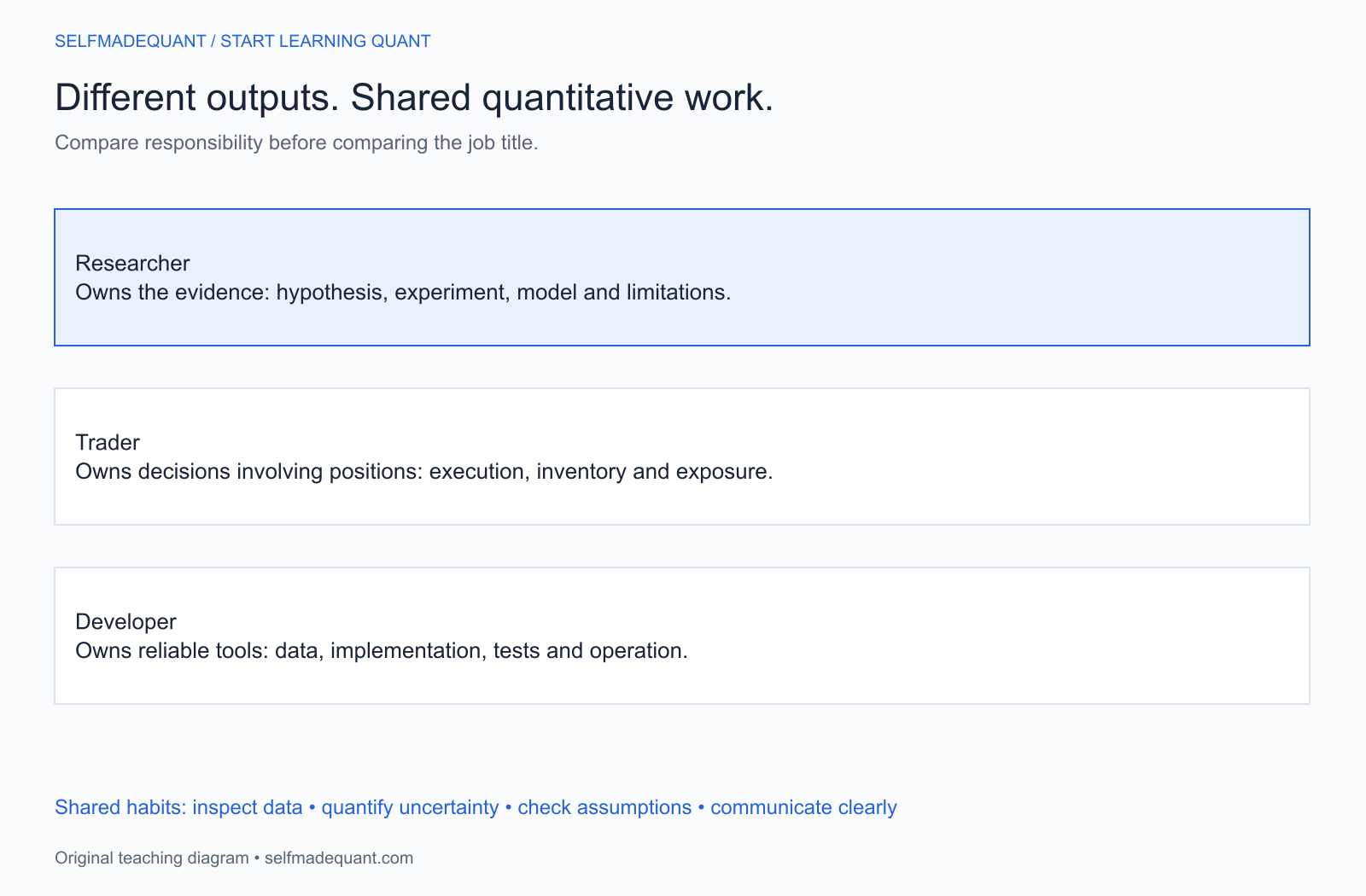
The comparison at a glance
| Dimension | Quant researcher | Quant trader | Quant developer |
|---|---|---|---|
| Main question | Does the model or hypothesis provide useful evidence? | What should we trade, quote or hedge, and under which limits? | Can the workflow run correctly and reliably? |
| Typical output | Experiment, model, forecast or research conclusion | Positions, execution decisions and managed exposure | Data pipeline, library, research tool or trading component |
| Useful foundations | Probability, statistics, research design and coding | Probability, market mechanics, risk and coding | Programming, algorithms, data and domain knowledge |
| An important failure | Leakage, weak validation or an unstable finding | Unmanaged exposure, misunderstood fills or poor execution | Incorrect data, unreliable operation or untraceable results |
| A first learning project | Test a simple hypothesis against a baseline | Analyse a specified order's execution cost | Package and test a numerical calculation |
The table describes learning priorities, not a ranking. Researchers need engineering habits; traders need evidence; developers need to understand the decisions their software serves.
What does a quantitative researcher do?
A researcher turns a question into a testable model or experiment. The work may involve market data, economic observations, company information, pricing relationships or other inputs. The researcher chooses a representation, constructs a fair comparison, investigates failures and communicates what the result supports.
For example: does a proposed signal contain information beyond an existing baseline? You need to define the target, align observations with their availability times, separate development from evaluation, and account for costs where the intended use involves trading.
An improvement in a fitted metric is not automatically an improvement in a financial decision. A forecast can improve while turnover makes the strategy less useful. A model can appear stable until you change the universe or remove an accidentally forward-looking variable.
What does a quantitative trader do?
A quantitative trader connects information and models to trading decisions. Depending on the desk, the work can include quoting, monitoring automated strategies, managing inventory, adjusting risk, investigating unusual behaviour and reviewing executions with researchers and engineers.
Imagine a model estimates value at 100.20 while the market offers an opportunity to buy at 100.10. The difference of 0.10 is only the start of the decision. What size can you execute? How uncertain is the estimate? What happens to your existing exposure? Are fees, hedging costs and adverse selection large enough to consume the difference?
The trader's responsibility concerns the decision under those conditions. It does not imply that every trader manually sends every order. Automation can change the speed and mechanics while leaving meaningful decisions about risk and strategy behaviour.
What does a quant developer do?
A quant developer makes quantitative work usable through software. One role might focus on research tools and data pipelines; another on pricing libraries, execution infrastructure or performance-sensitive systems. The title does not identify the latency requirement or programming language by itself.
Suppose two researchers obtain different results from the same notebook. The engineering investigation may uncover different dependency versions, a silently updated dataset, an implicit timezone assumption or a model parameter stored only in memory.
Repairing that workflow requires more than speeding up the numerical calculation. You need explicit inputs, traceable versions, tests, failure handling and a repeatable execution process.
Research engineering often involves close collaboration with model users. A well-designed interface prevents an invalid unit or timestamp from quietly entering the experiment. A useful error message can save more time than a faster loop.
One project, three role-specific investigations
Take a hypothetical daily trading rule. Rather than creating three unrelated projects, investigate it through three lenses.
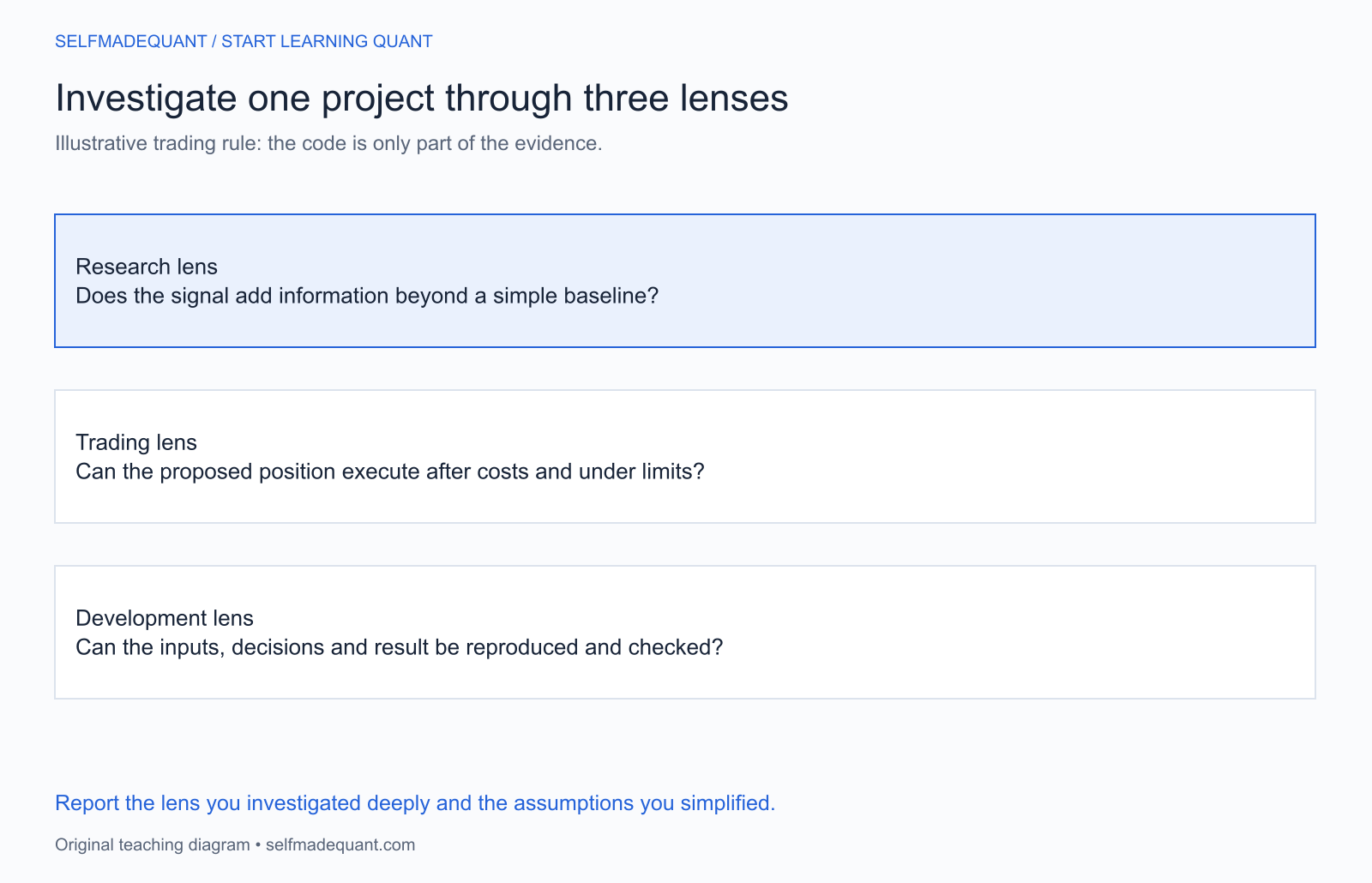
A good presentation explains which lens you investigated deeply and which you simplified. You do not need to imply that a beginner project reproduces an institution's complete production process.
Where do pricing, portfolio and risk quants fit?
The researcher–trader–developer comparison leaves out important specialisms.
These roles can also involve research and development. A pricing quant may write substantial software; a validation quant may build a challenger model. Start with the intended output and decision rather than forcing every vacancy into three labels.
How to choose a role to investigate first
Ask which difficult activity you are willing to repeat. Do you enjoy investigating why an experiment failed? Making decisions with incomplete information? Tracing a software failure and improving a tool? Understanding a contract deeply enough to explain a pricing disagreement?
Use small projects to test those preferences. Enjoying a textbook subject does not tell you whether you will enjoy the associated workflow. Equally, one frustrating debugging session does not establish that engineering is the wrong path.
Then read vacancies and ask practical questions:
- What output does the role own, and who uses it?
- How does research become a production decision?
- Which languages, data and systems are central to the actual work?
- How are models reviewed and failures handled?
- What does a junior person produce in their first months?
These questions reveal more than title prestige or an unsourced compensation comparison. This article deliberately does not present a salary league table: geography, experience, firm, performance and pay structure can dominate title-level comparisons.
Frequently asked questions
Which quant role requires the most maths?
There is no reliable universal ordering. Research and pricing roles can demand substantial probability, statistics or stochastic analysis; engineering roles can demand deep numerical or algorithmic reasoning. Examine the particular work and its mathematical dependencies.
Can a developer move into research or trading?
Skills can transfer, especially domain knowledge and reliable implementation, but the destination role adds responsibilities that require evidence. A transfer is not automatic. Test the missing research or decision-making skills in a scoped project and compare them with actual role requirements.
Does every quant developer need C++?
No single language requirement covers the whole category. Some roles emphasise C++ and systems performance; others focus on research infrastructure or scientific Python. Learn Python to begin numerical work, then choose additional skills from the role and project requirements.
Choose the work, then the preparation
Download the accompanying Python examples
Go deeper with lessons, derivations and worked exercises behind this article.