How to prepare for a quant interview: a role-specific study plan
Prepare for a quant interview by identifying the role, diagnosing your current gaps, practising worked problems, and then solving unfamiliar variations aloud. Combine probability, statistics, coding and relevant financial reasoning in proportions that match the vacancy. Use a study cycle with evidence of progress rather than treating a fixed number of questions or weeks as a guarantee of readiness.
It is easy to spend every evening reading solutions and feel familiar with the material. The more useful test comes the next day: can you solve a changed problem without the solution, explain the assumptions, and respond when the interviewer alters one of them?
Step 1: identify the actual interview target
Read the vacancy and the employer's current preparation material. Record the role, required skills, assessment format if stated, and deadline. Separate explicit information from your assumptions.
Step 2: run a short diagnostic
Try the following without looking at solutions. Write down the reasoning, not just a number.
| Diagnostic | A useful answer should show | Where to repair the gap |
|---|---|---|
| Two dice, at least one six: probability both six? | Ordered sample space and conditioning event; answer 1/11 under the stated event | Conditional probability problems |
| Expected fixed points in a random permutation? | Indicators and linearity; answer one | Expected value problems |
| Mean 10 bp, independent-formula SE 20 bp: what does a 95% approximate interval say? | Interval about [−29.2, 49.2] bp and correct interpretation | Statistics problems |
| A customer buys your ask: which position do you hold? | Cash received, short settlement exposure and conditional information | Market-making problems |
| Join releases at times 2 and 5 to a decision at time 1 | No released value; prevent negative-index hindsight | Python problems |
| Explain your own project in five minutes | Question, data, benchmark, strongest check and limitation | Project presentation guide |
Classify each failure: concept gap, modelling error, algebra, implementation, interpretation or communication. The same wrong answer can arise from different causes and require different practice.
Avoid treating this small diagnostic as a hiring assessment. Its purpose is to choose your next study action.
Step 3: choose a role-specific emphasis
| Target | Early practice priorities | Add domain questions when relevant |
|---|---|---|
| Quant trading | Conditioning, expectation, decision-making under uncertainty, clear arithmetic | Market making, inventory, instruments and execution |
| Quant research | Probability, estimation, inference, model comparison and coding | Time-series dependence, leakage, selection and research defence |
| Quant development | Algorithms, data structures, implementation and debugging | Numerical reliability, data timing, systems and the models supported |
| Pricing or model development | Probability, calculus, numerical methods and no-arbitrage reasoning | Derivatives, sensitivities, stochastic models and calibration |
| Portfolio or risk | Covariance, estimation, optimisation and scenarios | Factors, tail risk, constraints and model challenge |
These are recommendations for allocating study effort. Actual roles may combine several rows or assess other subjects. If a required topic is missing, add it from the vacancy rather than assuming the table is exhaustive.
Step 4: use an eight-week preparation cycle
The template below assumes six planned hours per week, giving 48 hours in total. It is an arithmetic study budget, not an estimate of the time every candidate needs. Extend a phase when its checkpoint is incomplete.
| Weeks | Focus | Evidence to produce |
|---|---|---|
| 1–2 | Diagnose and repair foundations | Independent solutions to changed probability and coding questions |
| 3–4 | Deepen the role's main topics | Worked methods plus follow-ups in statistics, markets or numerical work |
| 5–6 | Mix unfamiliar questions and discuss projects | Recorded or observed explanations and a defensible project summary |
| 7–8 | Run mocks, repair recurring errors and review requirements | A clear error log, successful re-attempts and a targeted final review |
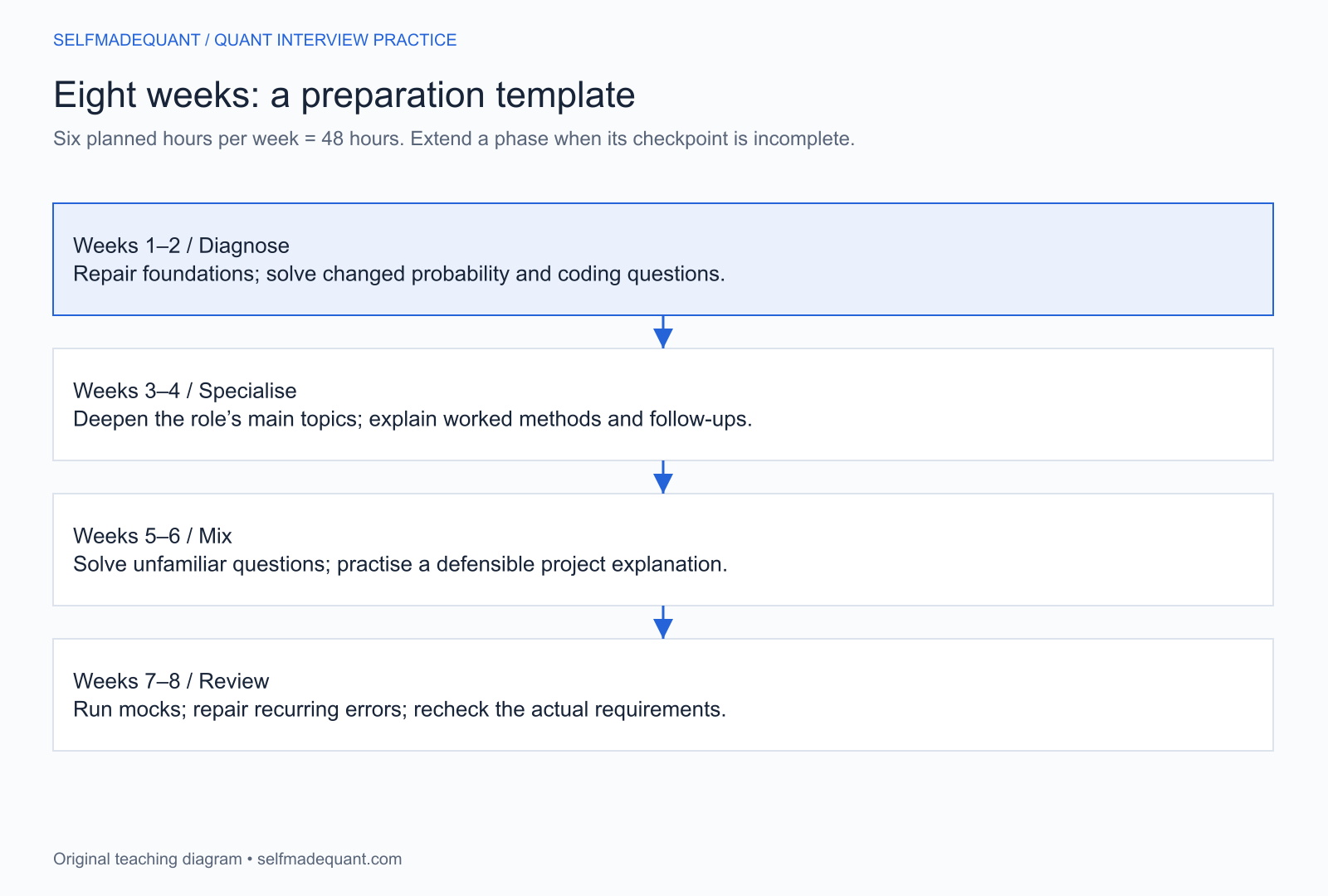
For a six-hour week, one possible allocation is two hours solving unfamiliar questions, ninety minutes repairing concepts, ninety minutes doing changed re-attempts, and one hour on a mock or project discussion. Include review and debugging within those blocks.
Step 5: make every reviewed solution produce another attempt
Use a three-part loop. First attempt the problem without notes. Then compare the reasoning and repair the specific gap. Later, solve a variation without the original solution in view.
For conditioning, change the reporting rule. For expectation, change dependence or the state transition. For statistics, change the sampling structure. For coding, change timestamps, missing values or the required complexity.
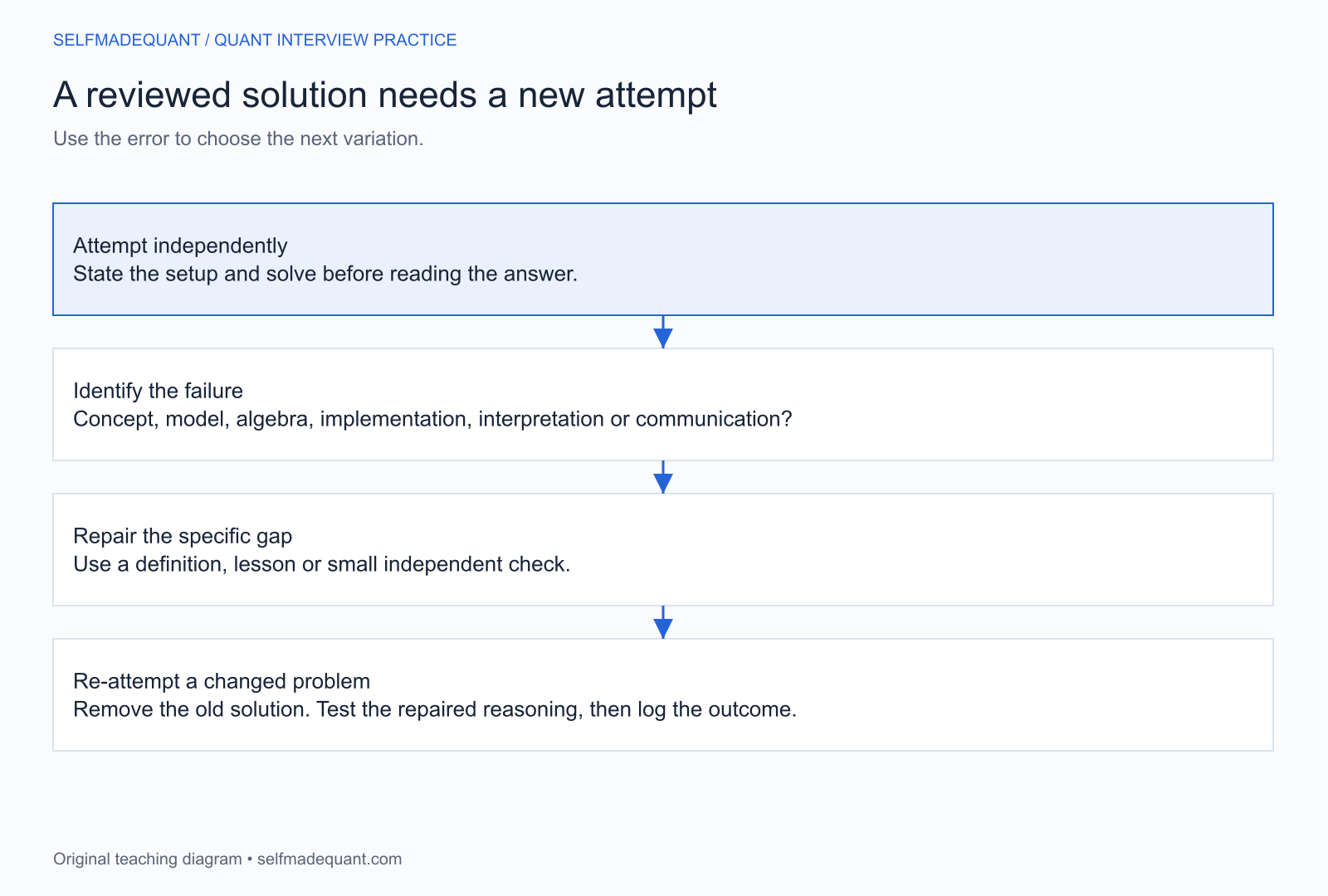
Keep a concise record: question, decisive assumption, failure, repair, variation and outcome. Do not record only solved-question counts. Ten copied solutions and one independently solved unfamiliar variation are different kinds of evidence.
Avoid a rigid time limit before you understand the method. Once you can solve accurately, use time constraints to practise prioritising and communicating the important steps.
Step 6: practise an interactive mock session
Here is a suggested 30-minute practice format. It is not an employer's interview schedule.
| Minutes | Activity | What to observe |
|---|---|---|
| 0–3 | Clarify the setup | Does the candidate identify the target and important assumptions? |
| 3–15 | Solve the main problem | Is the representation useful and the calculation inspectable? |
| 15–23 | Change one assumption | Can the candidate update the model rather than defend an obsolete answer? |
| 23–27 | Summarise and check | Are units, boundary cases and limitations clear? |
| 27–30 | Give feedback | Name one specific improvement and the next variation to attempt |
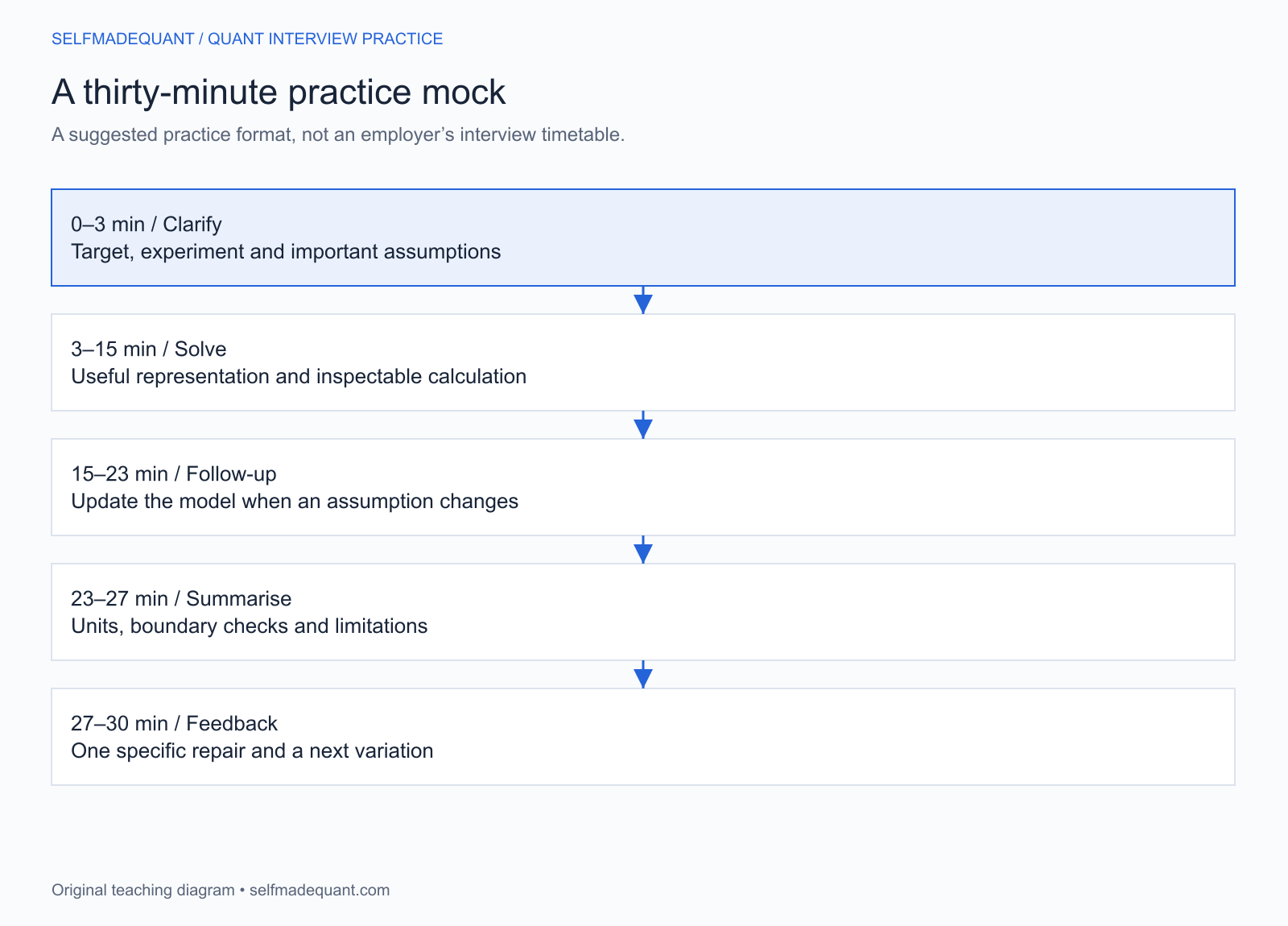
Ask the practice partner to provide a hint when needed and observe how you use it. Explain a mistake and correct it plainly. Continuing to defend a contradicted assumption makes it harder to demonstrate the reasoning you actually have.
If practising alone, record a spoken explanation and review whether someone could reconstruct the model from your words. Follow applicable platform and employer rules in an actual assessment; independent practice is not permission to use outside assistance during a restricted interview.
Step 7: prepare a project you can defend
Choose a project you understand deeply rather than presenting a long list of shallow implementations. Explain the decision or hypothesis, data provenance, information timing, method, benchmark, strongest check and main limitation.
For a backtest, be ready to trace one signal into a feasible position and cost. For a pricer, explain the contract, inputs and numerical benchmark. For a software tool, describe a failure case and how you tested it.
A failed result can be useful evidence if you can show what it ruled out. Do not replace an honest limitation with a performance claim you cannot support.
How to judge progress
Look for changed behaviour: you define the conditioning event before counting; you include dependence in uncertainty; you test information timing before interpreting a model score; you choose a benchmark before optimising code. Those are meaningful improvements even before your solution speed increases.
Use mock feedback to select the next question, then confirm the repair with an independent attempt. No single private score or checklist can establish how an employer will assess you.
What if the interview is next week?
Inspect the stated scope, repair the largest gaps and practise explaining a small number of methods and projects. Keep time for rest and setup. A compressed schedule cannot create missing foundations instantly; choose the highest-value work that is feasible now.
Should I study only brainteasers?
How many questions should I finish?
There is no universal number. Measure whether you can solve unfamiliar variations and explain assumptions independently. Use question counts as a record of activity, not as a substitute for evidence of learning.
Start the next practice session
Download the accompanying Python examples
Go deeper with lessons, derivations and worked exercises behind this article.