How many starting hands are there?
A Texas Hold'em player receives two cards from 52, so there are possible starting hands. Most interview questions about starting hands reduce to counting a subset:
| Event | Count | Probability |
|---|---|---|
| Any pocket pair | 13 ranks × = 78 | 5.88%, about 1 in 17 |
| Pocket aces | = 6 | 0.45%, 1 in 221 |
| Suited cards | 4 suits × = 312 | 23.5% |
| Ace–king, any suits | 4 × 4 = 16 | 1.21% |
A useful habit is to check a count from two directions. For suited hands: whatever the first card is, 12 of the remaining 51 cards share its suit, and 12/51 = 23.5%. Interviewers often ask for exactly this sort of second derivation.
What is an out, and how do you turn outs into a probability?
An out is an unseen card that improves your hand to one you expect to win with. After the flop you have seen five cards (your two and the three on the board), so 47 are unseen. Cards in opponents' hands are unknown to you, so they count as unseen too.
A flush draw has 9 outs: 13 cards of the suit minus the 4 you can see. The chance of hitting on the turn is
and the chance of hitting by the river is one minus the chance of missing twice:
The same method gives the other common draws:
- Open-ended straight draw, 8 outs: 31.5% by the river, 17.4% on the river alone.
- Two overcards, 6 outs: 24.1% by the river.
- Pocket pair that hits a set on the flop: 1 − C(48,3)/C(50,3) ≈ 11.8%, about 1 in 8.5.
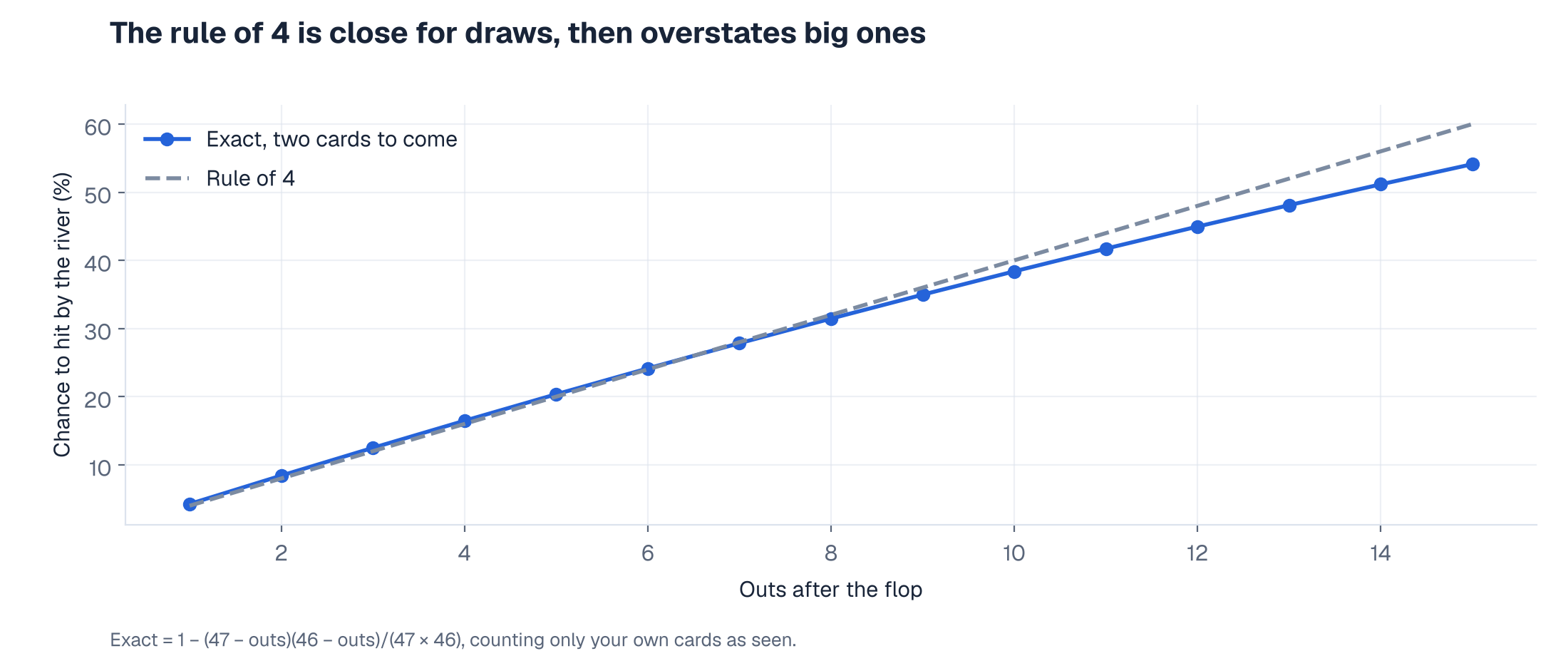
The rule drifts as outs increase because it ignores the chance of hitting on both cards. At 15 outs it says 60%, while the exact answer is 54.1%. Use it at the table; in an interview, give the exact expression first and the approximation second.
Outs are not equity
Hitting an out is not the same as winning. Some of your outs may also give an opponent a better hand: a card that completes your straight can complete their flush. And a hand can win without improving.
Equity is the share of the pot you would win on average if all remaining cards were dealt: your win probability plus half your tie probability in a heads-up pot. Against one random hand, before the flop, a simulation of 60,000 deals per hand gives:
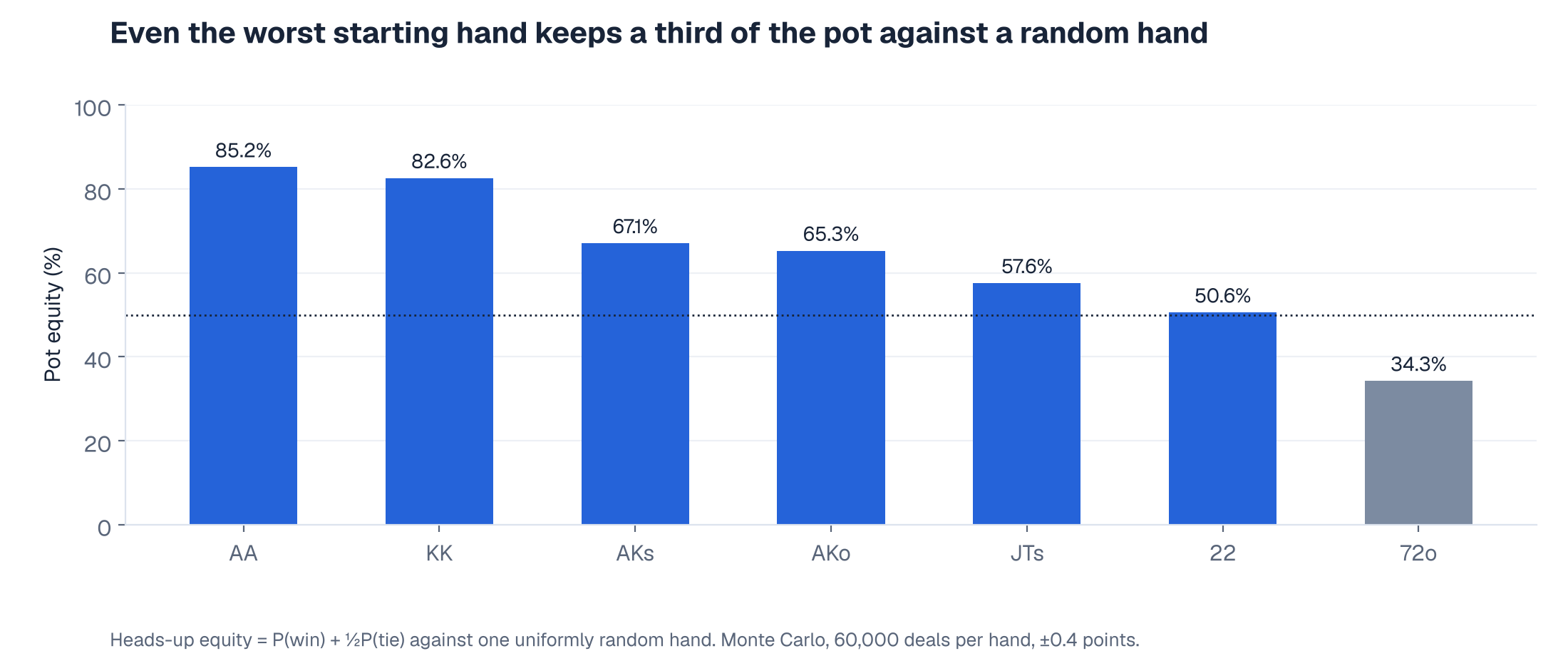
Pocket aces win about 85% of the time, but seven–two offsuit still takes about a third of the pot. Suitedness adds only about two points to ace–king. Note the qualifier "against a random hand". Against a player who raised, the opponent's range is far from random and every number here falls.
How do pot odds turn probability into a decision?
A call is a trade: you pay a price for a share of a future payout. The pot holds 50. To continue you must call 200. Your required equity is
On the turn, with a flush draw and one card to come, you hit with probability 9/46 ≈ 19.6%, below the 25% you need. Ignoring future betting, calling loses money on average: 0.196 × 150 − 0.804 × 50 ≈ −10.8 dollars. Facing the same bet on the flop as an all-in, with two cards to come and no further betting, your 35.0% exceeds 25% and the call is profitable.
Practice questions with answers
- Probability of being dealt a pocket pair twice in a row? Hands are independent, so (78/1326)² ≈ 0.35%.
- You hold two hearts and the flop has two hearts. Probability the board completes your flush by the river? 9 outs, two cards: 35.0%.
- Probability that at least one of your two cards is an ace? 1 − C(48,2)/C(52,2) = 1 − 1128/1326 ≈ 14.9%.
- The pot is 20. What equity do you need? 20/(60 + 20 + 20) = 20%. The final pot includes your opponent's bet and your call.
Common mistakes
- Counting 50 unseen cards after the flop. You have seen five, so 47 remain unknown to you, whatever the opponent holds.
- Adding probabilities for two cards. 9/47 + 9/46 = 38.7% double-counts the case where both cards hit. Use the complement.
- Using equity against a random hand after a raise. The opponent's range is conditional on their action. Updating that range is the real interview question.
- Forgetting ties. Pot equity includes half the tie probability. On paired or straight-heavy boards, ties can be several percent.
References
The pre-flop equities are SelfMadeQuant's own Monte Carlo estimates: 60,000 heads-up deals per hand against one uniformly random opponent, with sampling error of about ±0.4 percentage points. All other probabilities are exact combinatorial calculations shown in the text.