Most explanations stop at the definitions. This guide prices one option, computes all five Greeks, and then checks them against a full repricing. That check is where the useful intuition lives: it shows when a Greek is a good guide to your profit and when it misleads you.
What are the Greeks for one at-the-money call?
| Greek | Value | Read it as |
|---|---|---|
| Delta | 0.560 | +1 rise in spot |
| Gamma | 0.0394 | delta rises by 0.039 per $1 rise in spot |
| Theta | −0.027 | loses about 2.7 cents per calendar day |
| Vega | 0.197 | +$0.20 per 1 point of volatility (20% → 21%) |
| Rho | 0.129 | +$0.13 per 1 point of interest rate |
For one contract of 100 shares, multiply each line by 100. Delta of 0.56 becomes a position that behaves like 56 shares; theta becomes about $2.73 a day.
Two of these readings deserve a second look. Delta is above 0.5 even though the option is exactly at the money. That is because the forward price of the stock sits above 100 when rates are positive, and because a lognormal model puts more weight on upward moves in price terms. And the vega figure is easy to sanity-check: raise volatility to 21% and the call reprices to 4.68, up by 0.197, just as vega predicted.
How accurate is delta for a real move?
Delta is a tangent line. Move spot from 100 to 102 and compare three answers:
- Full repricing at 102: 5.682.
- Delta only: 4.485 + 2 × 0.560 = 5.604, which is 7.7 cents too low.
- Delta plus gamma: 5.604 + ½ × 0.0394 × 2² = 5.683, within a tenth of a cent.
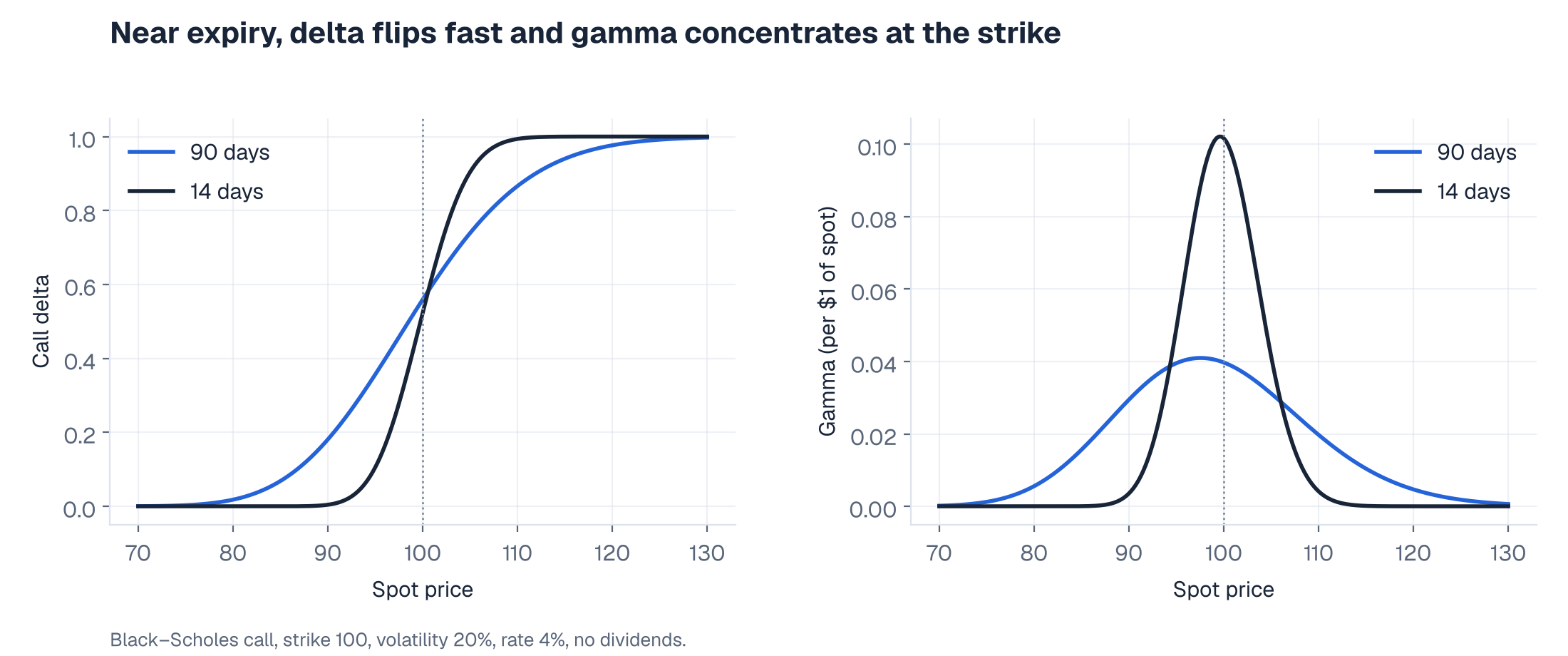
The error from delta alone is the curvature of the price, and gamma measures exactly that curvature. This is why traders describe a long option position as "long gamma": the payoff curve bends upwards, so a delta-only estimate always understates gains from a move in either direction.
Why does gamma spike near expiry?
Away from the strike, gamma is lower but not zero. A 90-strike call (deep in the money) has delta 0.89 and gamma 0.019; a 110-strike call has delta 0.21 and gamma 0.029. The out-of-the-money option has more gamma than the in-the-money one here because spot is closer to its region of uncertainty, measured in standard deviations.
For a trader this matters in two ways. A short at-the-money option close to expiry can swing from harmless to fully exercised on a small move, so its hedge has to be adjusted often. And because hedging costs depend on how often you rebalance, high gamma means high transaction costs for the hedger.
Why does time decay speed up?
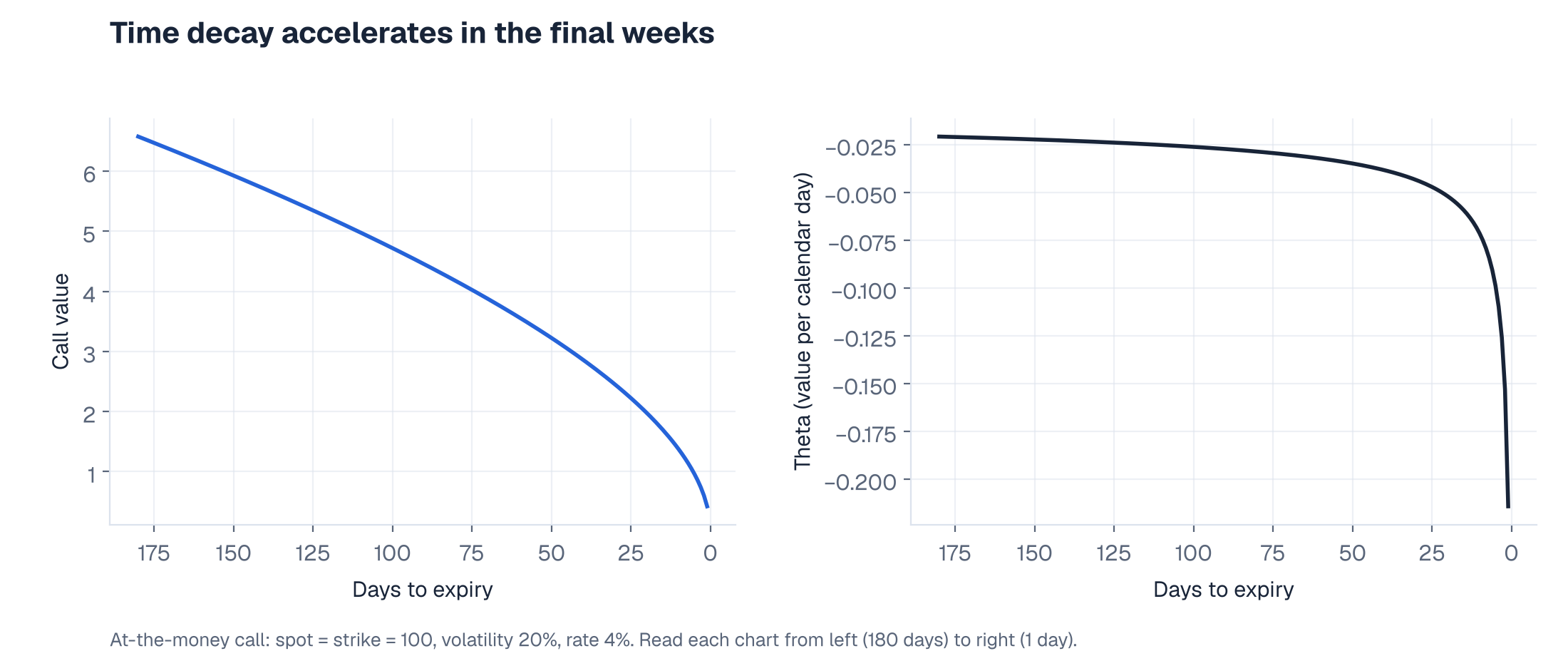
| Days to expiry | Call value | Theta per day | Gamma |
|---|---|---|---|
| 90 | 4.45 | −0.027 | 0.040 |
| 30 | 2.45 | −0.044 | 0.069 |
| 7 | 1.14 | −0.084 | 0.144 |
| 1 | 0.42 | −0.214 | 0.381 |
The at-the-money value scales roughly with the square root of time, so the last few days carry a large share of the remaining value and lose it quickly.
Theta and gamma rise together, and that is not a coincidence. In the Black–Scholes setting, a delta-hedged option's daily profit is roughly ½ × gamma × (actual move)² + theta. Theta is the rent you pay for gamma. If the stock moves more than the volatility you paid for implies, the gamma term wins; if it moves less, theta wins. Every long-option position is a bet on that comparison.
What does vega tell you, and what does it hide?
How do the Greeks add up across a position?
Greeks are linear in position size, so a strategy's Greeks are the signed sum of its legs. Buy a 100 call and sell a 110 call (a bull call spread) and you get:
- delta of 0.56 − 0.21 = 0.35;
- gamma of 0.039 − 0.029 = 0.010;
- vega of 0.197 − 0.145 = 0.052.
The spread keeps much of the bullish exposure while removing most of the volatility exposure. That is often the point of building a spread rather than buying a call outright.
Common mistakes when reading the Greeks
Where to go next
- Black–Scholes: why the expected stock return leaves the price derives where these sensitivities come from.
- What does an option price actually mean? separates price, payoff and profit.
- The Greeks and numerical sensitivities lesson computes them by finite differences and explains where numerical Greeks go wrong.
References
All figures in this article are computed from the Black–Scholes formula with the stated inputs. They are model values, not market quotes.