Stress testing: what if the volatility model is the wrong description of tomorrow?
A portfolio can pass its volatility limit and still be difficult to hold through a bad day. The forecast may miss a jump. A hedge may weaken. A margin call may require cash before the position can be sold at a reasonable price.
Stress testing asks what happens under specified adverse conditions. It complements a probability model by examining outcomes that deserve attention even when their estimated frequency is unreliable.
The distinction matters: a scenario loss is not automatically a probability-weighted risk measure. It is a conditional answer to a carefully described “what if”.
Start with a position you can reconcile
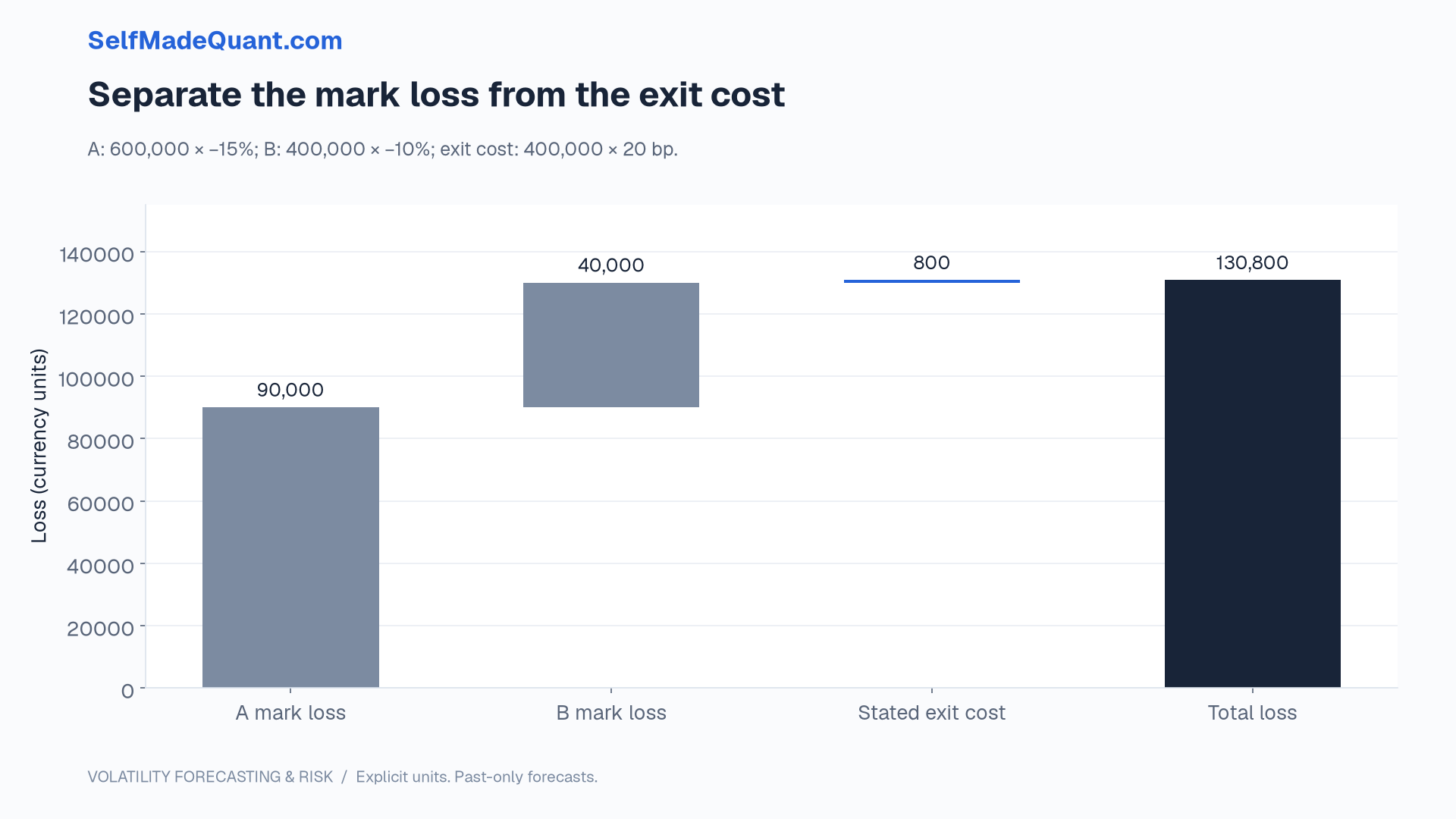
Consider a one-million portfolio with 600,000 in asset A and 400,000 in asset B. In a simultaneous scenario, A falls 15% and B falls 10%.
With fixed holdings, no cash flows and simple returns, the marked loss is:
That is a 13% capital loss before financing or liquidation costs. It does not depend on calculating a historical covariance matrix.
If you then liquidate 400,000 of notional at an additional twenty basis points of one-way execution cost, the cost is 800. State whether this cost is measured relative to the already stressed mark. Otherwise a scenario can count part of the adverse price movement twice.
The full portfolio liquidation would involve a different notional and potentially a different cost assumption. “Twenty basis points” is incomplete until you specify what is traded and which price serves as the reference.
Build scenarios around mechanisms
A historical replay applies a past collection of market changes to today's positions. It can be informative without implying that the instruments, liquidity or market structure are identical today.
A hypothetical scenario can isolate a mechanism: a currency gap, a yield-curve twist, an implied-volatility jump or a basis divergence. Combining mechanisms requires a coherent joint story. Moving every risk factor independently to its worst historical value may create a scenario that is difficult to interpret economically.
A reverse stress test starts with an unacceptable outcome, such as exhausting a cash buffer, and asks which combinations of shocks and constraints could produce it. It should reveal vulnerabilities rather than provide an optimised story that makes the portfolio look safe.
For every scenario, preserve the market shocks, valuation convention, position date, execution assumption and any management response. Those choices should be reproducible without reading the author's mind.
Nonlinear holdings need revaluation
The fixed-stock example maps returns linearly into profit. Options and other nonlinear instruments can change their sensitivity as the market moves.
A delta-only approximation can miss curvature and changes in implied volatility. A delta-gamma-vega approximation can be useful locally, but a severe scenario may require full revaluation with an appropriate pricing setup.
Keep the horizon consistent. Revaluing an option after one day means updating time to expiry as well as the stressed market inputs. Using an expiry payoff while presenting the result as a next-day mark is a different calculation.
Include the underlying, curve, volatility surface and relevant basis inputs when they matter. If an input cannot be observed reliably in stress, disclose the resulting valuation uncertainty rather than hiding it behind a precise-looking total.
Market loss and cash need are different reports
An unrealised mark-to-market loss can trigger a realised cash demand through variation margin, collateral requirements or financing terms. A portfolio with a manageable terminal payoff can still fail to meet an interim funding need.
Imagine a scenario in which a broker requires an additional 100,000 of collateral. That is a funding requirement. It is not automatically another 100,000 of economic loss to add to the price-loss total.
Report cash available, cash required, the time of the requirement and the assets that can actually be monetised. Do not assume that selling an illiquid holding produces immediate cash at its last modelled mark.
This distinction also prevents a favourable long-run thesis from answering a short-run survival question. The portfolio must meet its obligations along the path, not merely at the final valuation date.
A model shock can be as important as a market shock
Repeat the report with different covariance estimates, heavier tails or a delayed volatility response. Change the assumed hedge relation. Extend the liquidation interval. Replace a single execution cost with a range linked to the amount traded.
These are sensitivity analyses of the risk process. They should identify which conclusions depend on a narrow parameter choice.
If a modest change flips a portfolio from acceptable to unacceptable, the report should show the boundary. An average across assumptions may conceal the exact fragility the stress exercise was meant to expose.
Do not award a probability without a model
Calling the 13% example a “one-in-a-hundred event” requires more than choosing a severe-looking pair of returns. A scenario table specifies outcomes; a probability statement needs a distribution, calibration and dependence assumptions.
Similarly, a 99% VaR is not a substitute for every relevant stress. It describes a quantile under its model, whereas an operational failure, a funding constraint or a discontinuous repricing may require a separate scenario treatment.
Finish with an action that can be evaluated
A useful report names the exposure causing the loss, the constraint that binds and the proposed response. Then it states the cost and timing of that response.
“Reduce risk” is too vague. “Reduce the specified asset notional before the next funding deadline, using this execution assumption” is a policy you can inspect and challenge.
Next, we will bring the forecasts, timestamps, tail thresholds and limitations together in one reproducible project. Its most useful output will be a record that shows exactly which conclusions the data support.
Until then, peace.
Go deeper with lessons, derivations and worked exercises behind this article.