Finance for quants: exposure, leverage and the contract you actually trade
Two accounts can hold the same asset and report very different percentage returns. The difference may come from financing rather than forecasting skill. Before comparing strategies, identify the asset exposure, the equity supporting it and the contractual cash flows.
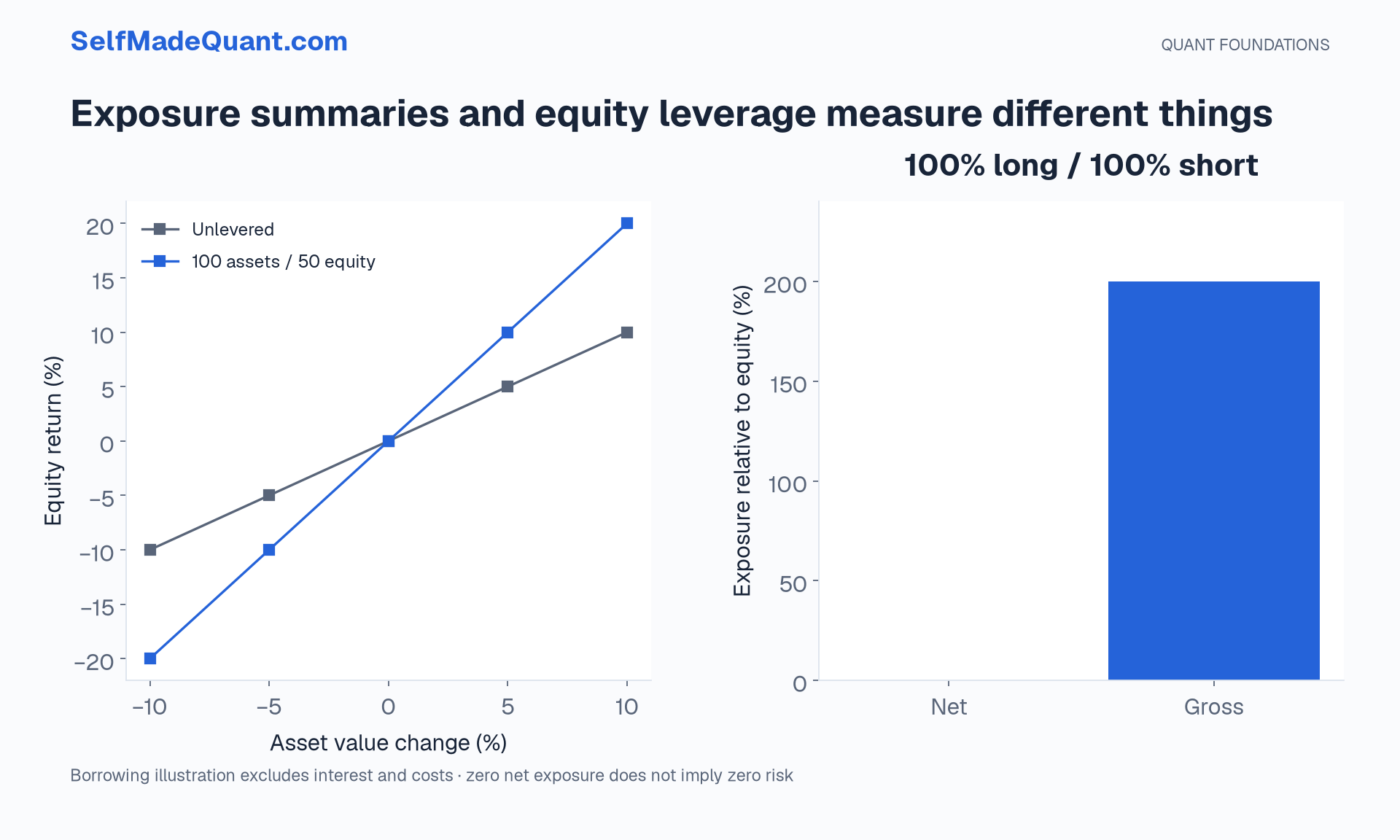
Suppose you buy an asset worth 100, using 50 of your own capital and borrowing 50. The asset rises to 110. Ignore interest, fees and collateral constraints for the moment. Repay the 50 debt and equity becomes 60: a 20% equity return from a 10% asset move.
The arithmetic runs in both directions. If the asset falls to 90, equity becomes 40, a 20% loss. Leverage amplified the exposure to the same price change. It did not improve the underlying forecast.
Net exposure does not describe the whole book
Define position weights relative to account equity, with negative weights for shorts. Net exposure is their sum. Gross exposure is the sum of their absolute values.
A book long 100% in A and short 100% in B has zero net exposure and 200% gross exposure. It can still lose money if A falls and B rises. Zero net weight does not establish zero factor exposure, zero volatility or zero funding requirement.
Likewise, a 60/40 long-only portfolio has 100% net and gross exposure, while its risk depends on volatilities and dependence. Exposure summaries are useful checks, not complete risk models.
A short position has a cash and collateral story
In a simple share short, borrowed shares are sold and later bought back for return to the lender. If the sale price is 100 and the repurchase price is 90, gross trading gain is 10 per share.
Borrow fees, dividend compensation, execution costs and funding can reduce that gain. The sale proceeds may be restricted as collateral. They should not automatically be treated as freely spendable cash earning a convenient rate.
If the price rises, the short loses. A fixed share short's loss has no finite bound as the share price rises without bound in the model. Real positions also face borrow availability, recalls and margin rules. Those operational conditions affect whether a theoretical trade can remain open.
A forward's price is not an upfront premium
A forward specifies a future transaction. In a frictionless teaching market with a non-dividend-paying asset, spot S0 and continuously compounded rate r, the fair delivery price is S0 exp(rT).
For S0 = 100, r = 5% and T = one year, that is about 105.1271. Under the model, the initially fair forward has zero value before transaction costs. Its delivery price is not an amount paid upfront to acquire the contract.
The reasoning compares buying the asset now with borrowing the purchase cost and repaying at maturity. It relies on the stipulated funding and carrying assumptions. Dividends, storage, differing borrowing rates or trading restrictions change that replication problem.
Once the contract exists, its value can change even though its agreed delivery price stays fixed. Price, delivery price and contract value are different objects; name them separately in code and reports.
Futures change the cash-flow timing
A futures position has variation-margin cash flows as settlement prices change. A forward generally concentrates settlement at the contract's settlement date, subject to its collateral agreement.
Even when their terminal economic exposure looks similar, those intermediate cash flows create funding and liquidity considerations. A terminal payoff diagram cannot show every account requirement along the path.
Do not assume that equal notional implies equal cash needed. Notional describes a scale for contractual exposure. Margin is collateral required under specified rules. Maximum loss and funding needs require further analysis of the actual contract and position.
Turn the description into an account check
For every position, record quantity, current price, market value and sign. Separate asset value, debt, cash and equity. State which flows are trading profit, financing, fees, collateral transfers or external capital.
Then stress the account with a simple price change. A long position should gain when its price rises, all else equal. A short should lose. Borrowing should amplify equity sensitivity according to the exposure supported by that equity. If these checks fail, a more complicated model will only make the error harder to see.
These examples explain specified accounting models. They do not measure the profitability or suitability of a leveraged investment.
Until then, peace.
Go deeper with lessons, derivations and worked exercises behind this article.