Finance for quants: follow the cash before fitting the model
A model can predict a payment accurately and still value it incorrectly if it puts the cash on the wrong date. Before stochastic calculus, learn to write a contract's cash flows, name their currency and dates, and distinguish a price from a return.
Consider a certain payment of 100 one year from now. In a teaching market with an annual effective risk-free rate of 5%, one unit invested today becomes 1.05 at the payment date. The amount needed today to reproduce the future payment is 100/1.05, approximately 95.2381.
That is a replication calculation under explicit assumptions. It is not a recommendation to buy a particular security. Credit risk, funding differences, collateral and trading restrictions can all change the real economic problem.
Put cash on a timeline
Write today as time zero. A payment received later cannot be added to today's cash without specifying a conversion between dates. Discounting makes that conversion under a chosen rate convention.
This expression assumes annual payment intervals and a single annual effective discount rate y. A term structure uses different discount factors by maturity. A floating payment requires a model or observed fixing for the amount, not merely a different denominator.
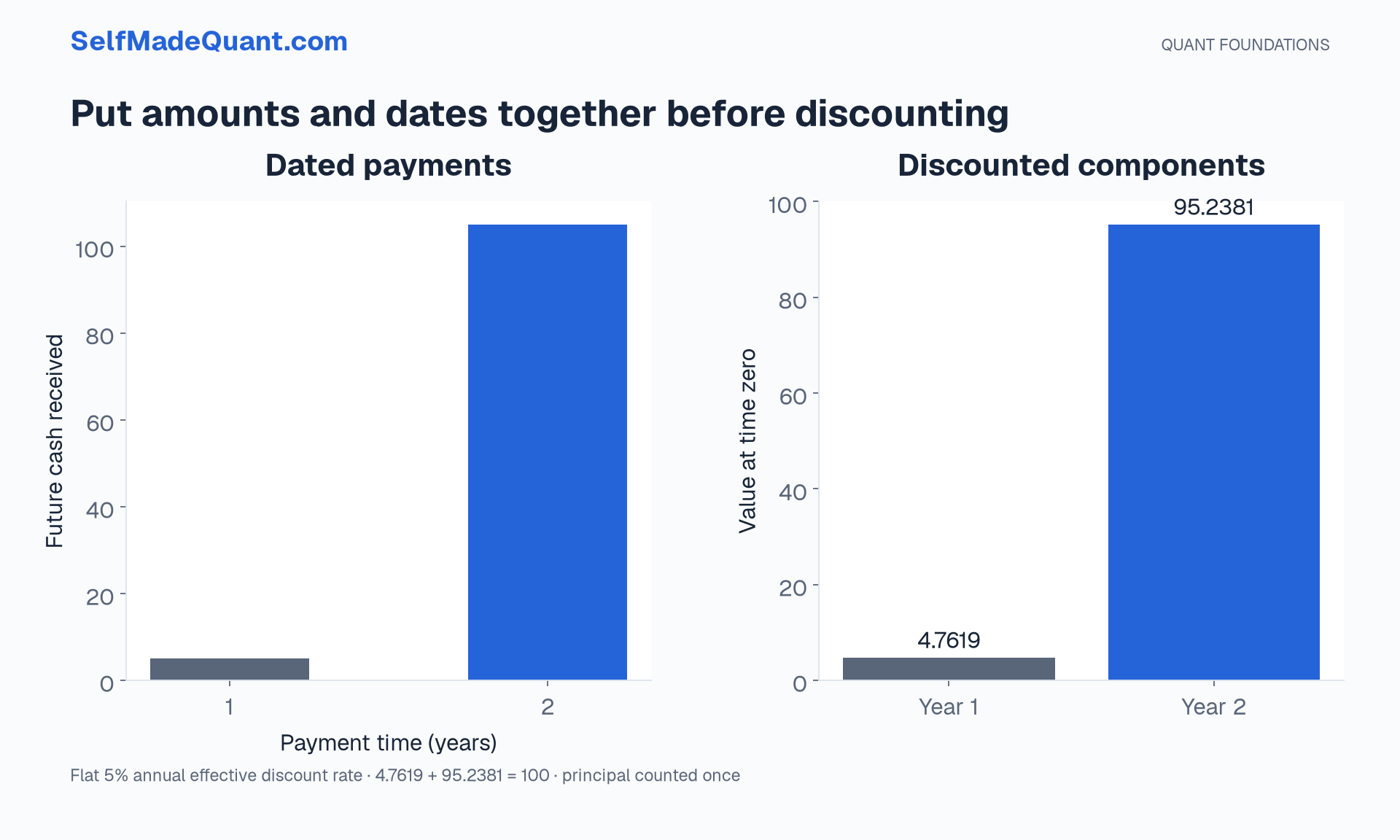
A two-year instrument paying 5 after year one and 105 after year two is worth exactly 100 at a flat 5% annual effective discount rate. The 105 combines the final coupon and principal repayment. Counting the principal twice would make the price wrong before any statistical estimation begins.
Compounding conventions describe different numbers
An annual effective rate of 5% means a year-end multiplier of 1.05. A continuously compounded rate giving the same multiplier is log(1.05), approximately 4.8790%.
Using 5% as a continuously compounded rate instead gives a multiplier of exp(0.05), approximately 1.05127. The difference is small here but systematic. Mixing conventions can contaminate comparisons and sensitivities.
Frequency matters as well. A quoted nominal rate convertible monthly requires its monthly conversion before compounding twelve periods. The label “annual rate” is insufficient unless you know what the quote means.
When documenting a calculation, include the quote convention, time unit and day-count assumption. Two systems can implement different conventions correctly and still disagree because they value different inputs.
Price is not payoff, and payoff is not profit
Suppose an option has a terminal payoff of 10 and costs 6 today. Ignoring financing and costs, its profit is 4. The payoff alone does not measure the return on the capital paid for the option.
If funding is included, carry the initial cost to the same date as the payoff before subtracting. With a 5% one-year funding rate in this simplified example, a funded cost of 6 becomes 6.30. Terminal profit becomes 3.70.
The calculation uses a stated funding assumption, rather than establishing an option's fair price. A forecast of the payoff distribution and a pricing rule are distinct inputs. A high expected payoff does not settle the price without considering timing and risk.
A return needs a denominator
Buy one share for 100 and sell it for 102. Receive a dividend of 1 during the holding period, with no reinvestment, fees or financing. Total holding-period gain is 3, and the simple return on initial outlay is 3%.
If there are external deposits or withdrawals, dividing ending wealth by starting wealth no longer isolates investment performance. Cash flows need their own treatment. If borrowed capital is involved, asset return and equity return differ.
Even without cash flows, compounding makes averages important. A gain of 10% followed by a loss of 10% turns 100 into 99. The arithmetic average return is zero; the compound result is −1%. The denominator changed after the first period.
The foundation lab checks these examples using the stated accounting conventions. These are deterministic checks, so they need no random generator. Their value is that every cash movement can be reconciled.
Read a term sheet with a model in mind
Identify the underlying, notional, currency, payment dates, settlement rule and optionality. Then ask which observations determine each payment and when those observations become known. A clean contract description comes before a clean model.
You do not need to master every derivative before starting quant work. You do need to distinguish cash instruments, forwards, futures and options, and to know which quantities represent prices, exposures, collateral and actual cash transfers.
Until then, peace.
Go deeper with lessons, derivations and worked exercises behind this article.