Projects / Phase 4.3 · JD to Projects
Systematic Volatility Trading and Delta-Hedged Options Book
When and how much BTC volatility to sell or buy on Deribit, in which tenors, and how to hedge it.
Headline result
A daily BTC options book on Deribit, scored once on 2023 to 2026. The volatility premium was +5.4 vol points, and a weekly short straddle had a Sharpe of 0.37 (0.60 with band hedging) at target size, but screen prints filled only 0.2% of that size. The conditional challenger lost USD 2.44m.
Figures
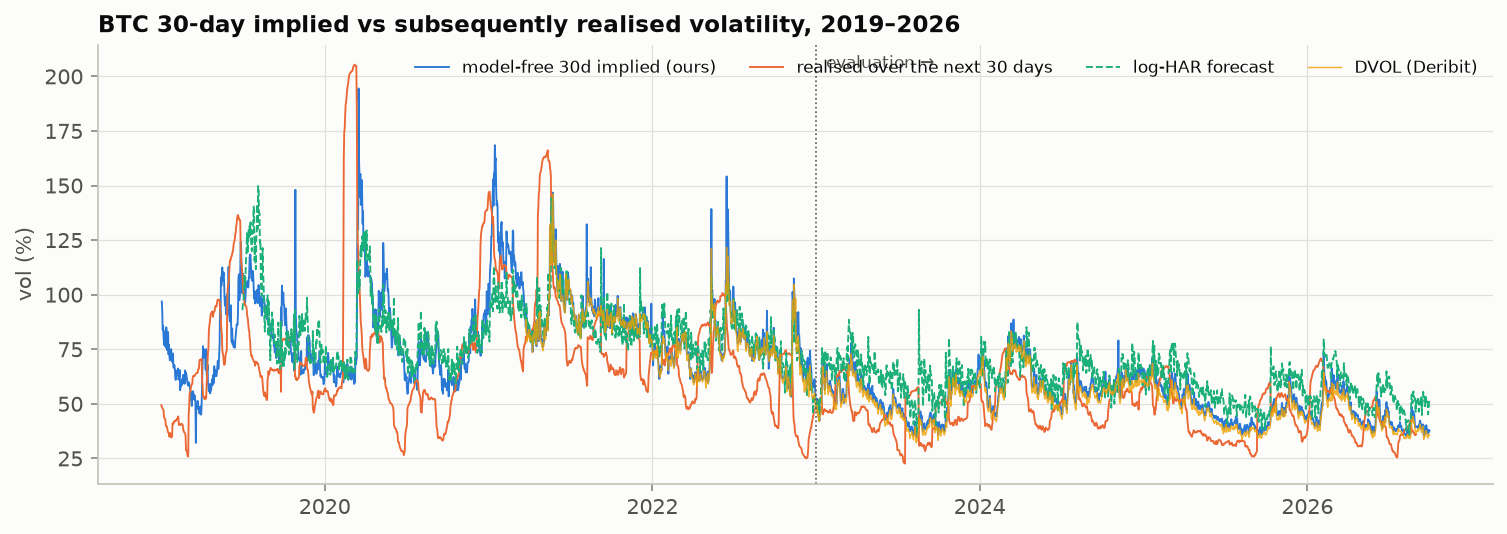
Implied mostly sits above realised: the premium averaged +5.4 vol points in the 2023 to 2026 evaluation, positive on 73% of days. 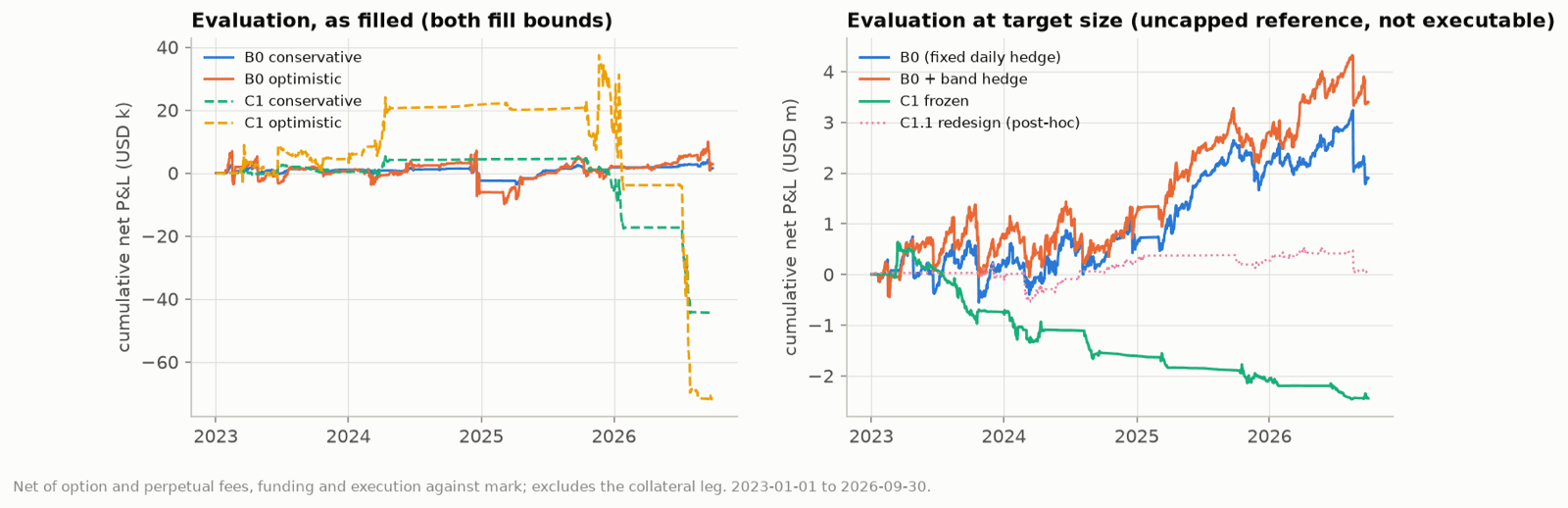
At target size the weekly short straddle with band hedging made USD 3.4m, while the forecast-driven challenger lost USD 2.44m; as actually filled, results are in thousands. 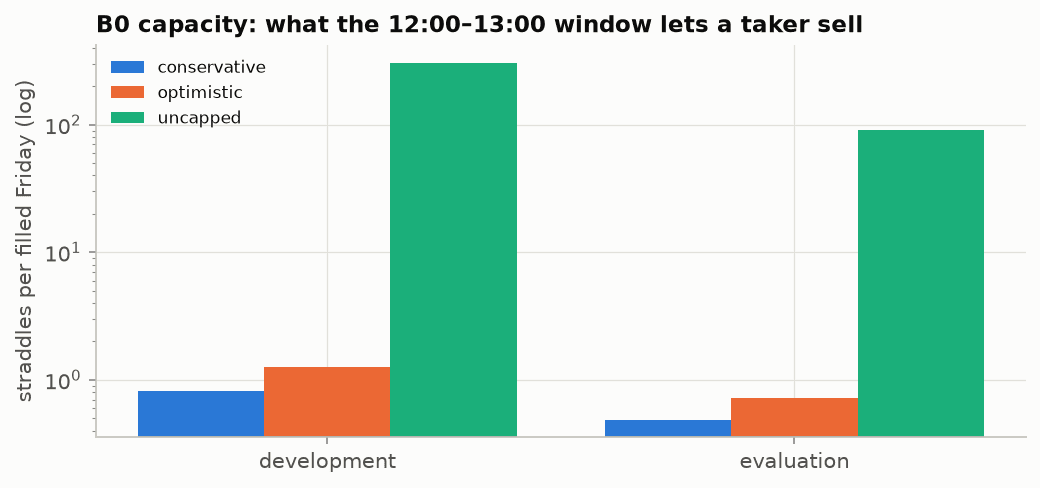
Conservatively, prints allow under one straddle per filled Friday: the short-straddle book sold 19.5 straddles in 3¾ years, 0.2% of its target size. 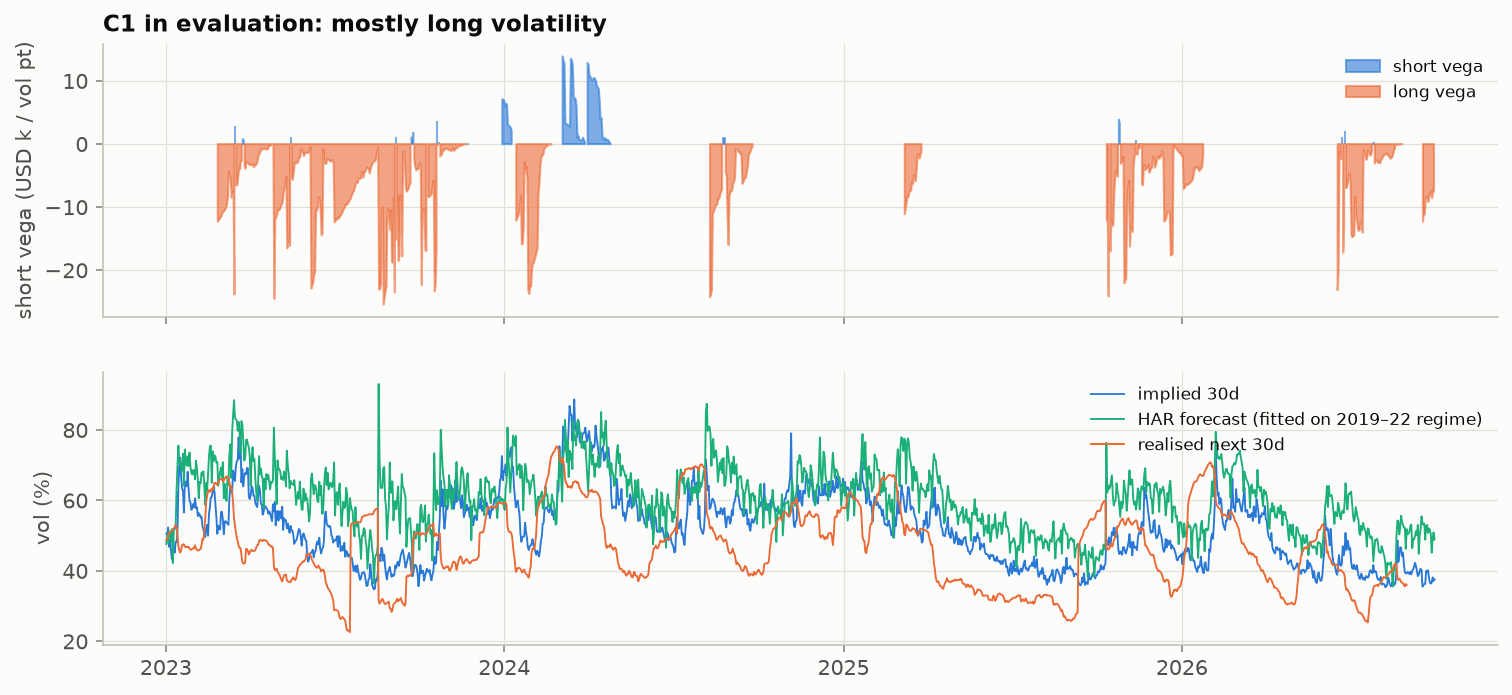
The HAR forecast, fitted on the 2019 to 2022 regime, sat above implied vol, so the forecast-driven challenger was long volatility on 466 days and short on 56.
Data used
- Deribit BTC option trade tape: 4.13m trades, 09:00–13:00 UTC daily, Jan 2019 to Sep 2026
- Deribit BTC perpetual 1- and 5-minute candles and hourly funding, Nov 2018 to Sep 2026
- Tardis.dev Deribit option order-book snapshots: 68 first-of-month days, Jan 2021 to Aug 2026
Built from Volatility Trader job descriptions
The role asks for
- Options pricing and Greeks
- Volatility surface and forecast modelling
- Delta hedging and tail risk
- Execution and transaction-cost analysis
- Statistics and optimisation
- Python and C++
This project uses
- SSVI/SVI surface fitting from trades
- HAR realised-variance forecasting
- Inverse-option pricing and P&L explain
- Whalley–Wilmott band delta hedging
- Fill model built from trade prints
- Deflated Sharpe for selection bias
Members open the full write-up, notebook, tested code and data in the project reader.