Projects / Phase 4.3 · JD to Projects
Swap Curves, Evaluated Pricing and Automated Quoting from Public Swap Trades
Which public swap prints to trust, what marks to publish with what grade, and how to auto-quote.
Headline result
A 15:00 ET SOFR curve, graded marks and an RFQ quoter built from DTCC’s public swap tape. The close reprices next-half-hour prints to 0.35 bp in liquid tenors, and grade C marks fall outside ±1 bp 8.2 times as often as grade A. The auto-quoter lost USD 416m on 112,028 replayed RFQs.
Figures
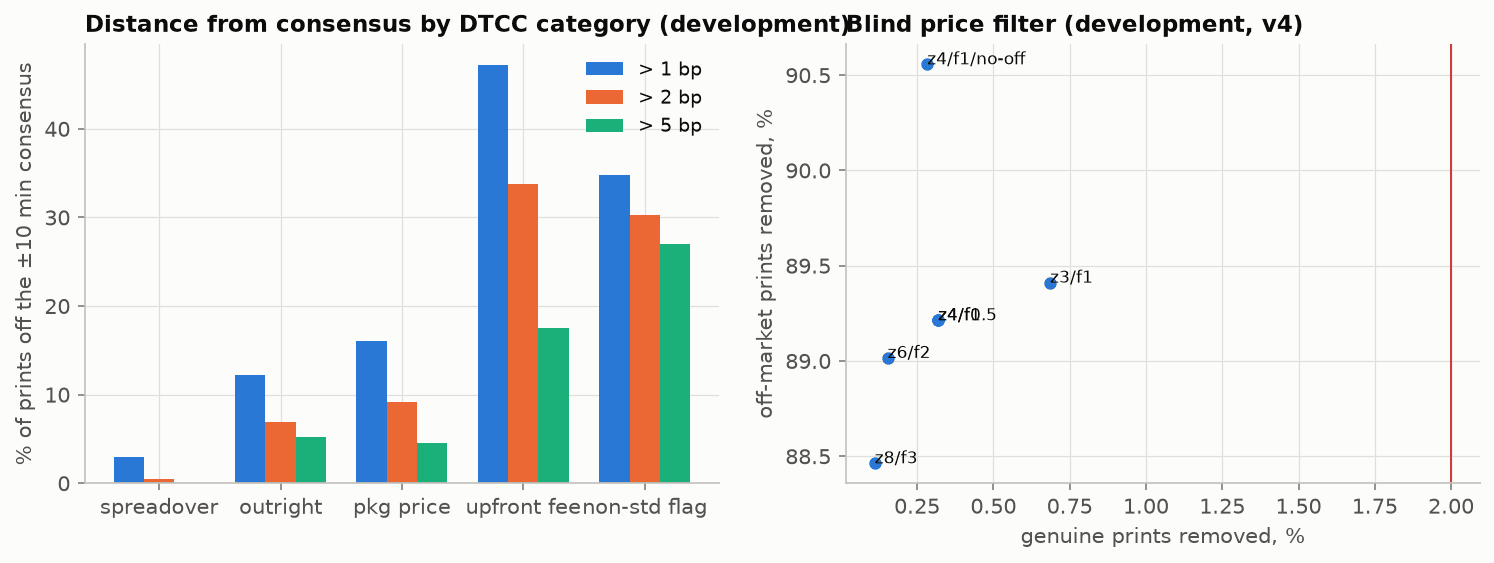
Spreadover legs are the cleanest inputs; in evaluation the blind filter removed 90.6% of off-market prints and only 0.22% of genuine ones. 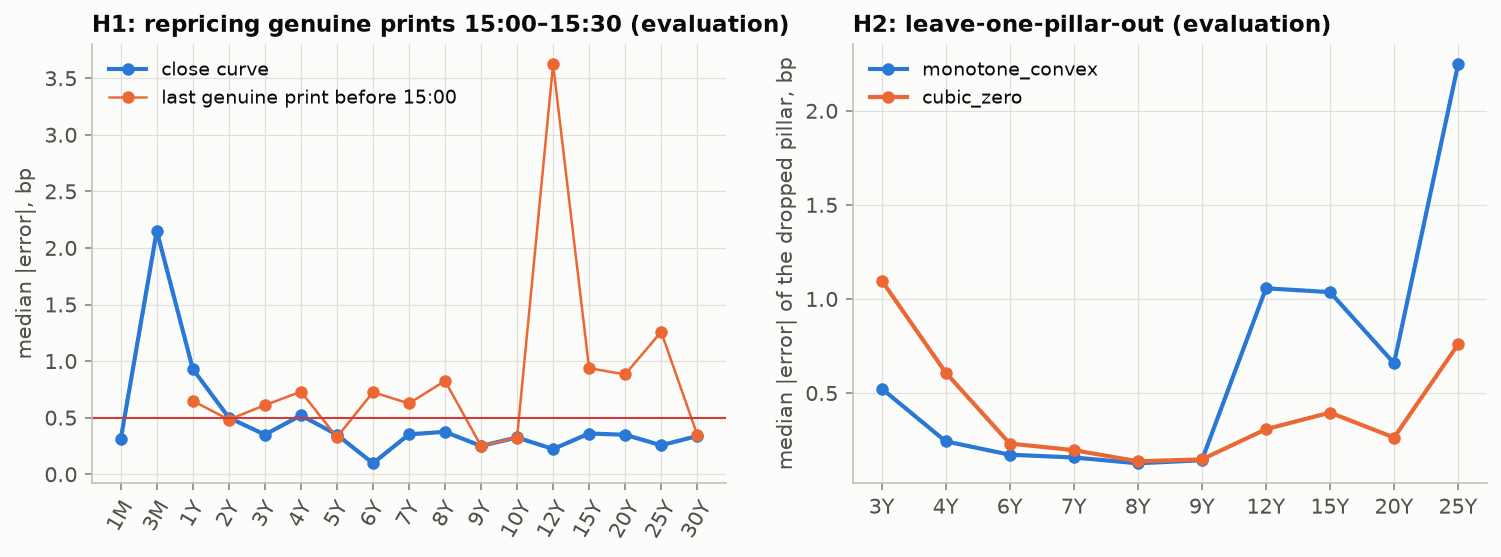
The close reprices genuine prints to a median 0.35 bp in liquid tenors; monotone convex wins short tenors, the spline from 12 years. 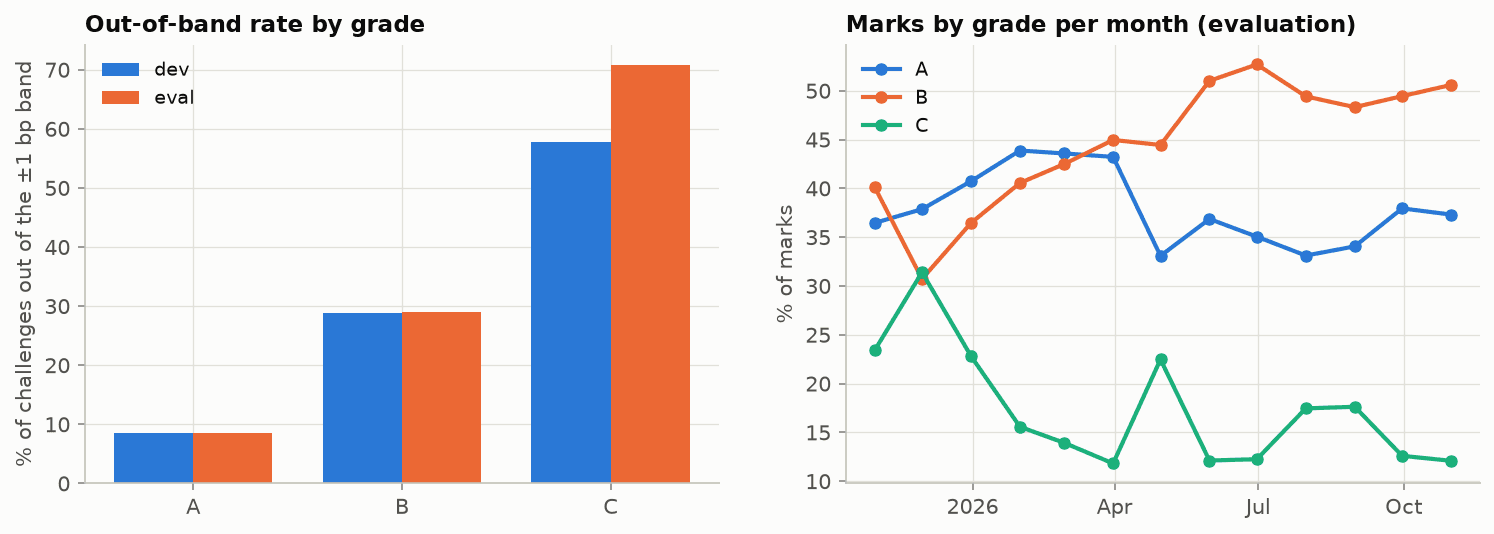
Grade C marks fell outside the ±1 bp band 70.7% of the time against 8.6% for grade A: 8.2 times as often. 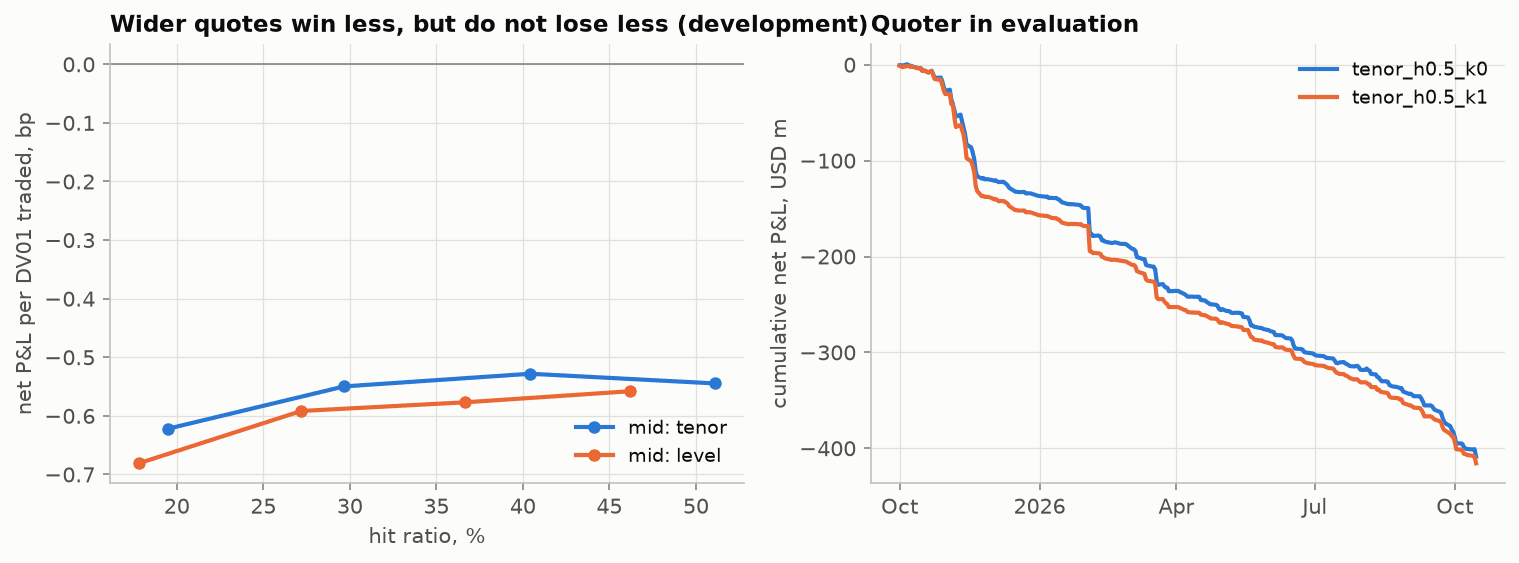
Every quote width loses 0.5 to 0.7 bp per DV01; in evaluation the quoter lost USD 416m on 112,028 replayed RFQs.
Data used
- DTCC public swap tape: 1.94m new SOFR fixed-float trades, Oct 2024 to Oct 2026
- NY Fed SOFR, EFFR and OBFR fixings, Jan 2023 to Oct 2026
- US Treasury daily par yields, Jan 2024 to Oct 2026, and Bloomberg SEF closes (521 days)
Built from Rates Desk Quant job descriptions
The role asks for
- SOFR curve building
- Rates derivatives pricing and marking
- Answering price challenges with evidence
- Risk and P&L explain
- Python and C++
- Automated RFQ quoting
This project uses
- Monotone-convex SOFR curve bootstrap
- Off-market print filtering
- Closing-price design from trades
- Mark grading and challenge loop
- Pillar DV01 P&L explain
- RFQ auto-quoter simulation
Members open the full write-up, notebook, tested code and data in the project reader.