Projects / Phase 4.3 · JD to Projects
Machine-Learning Signals on Limit-Order-Book Data
Is a short-horizon order-book signal real, robust and worth trading after costs?
Headline result
Order-book forecasters for BTC on Binance and Coinbase, scored once out of sample. Gradient boosting beat the linear baseline on every Binance day, but the frozen taker policy kept 0.46 bp per round trip against 8 bp of assumed fees and lost on all 121 days. It breaks even at 0.23 bp per side.
Figures
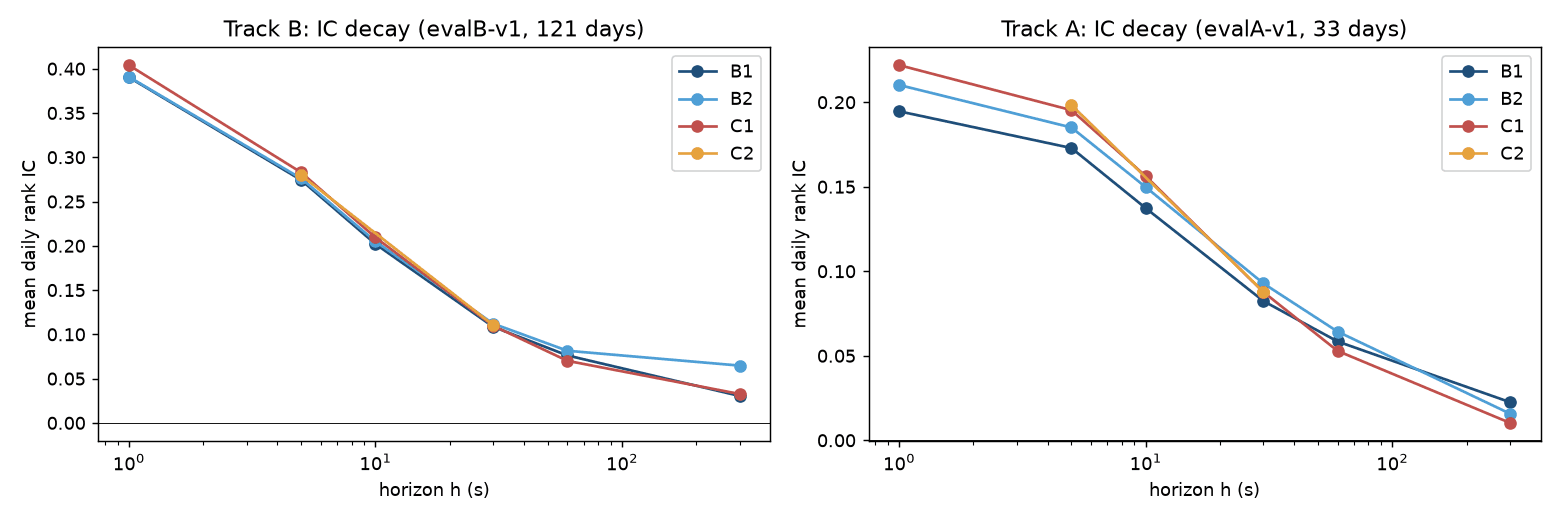
The signal is strongest at 1 s (IC about 0.40 on Binance, 0.20 on Coinbase) and has mostly faded by 300 s. 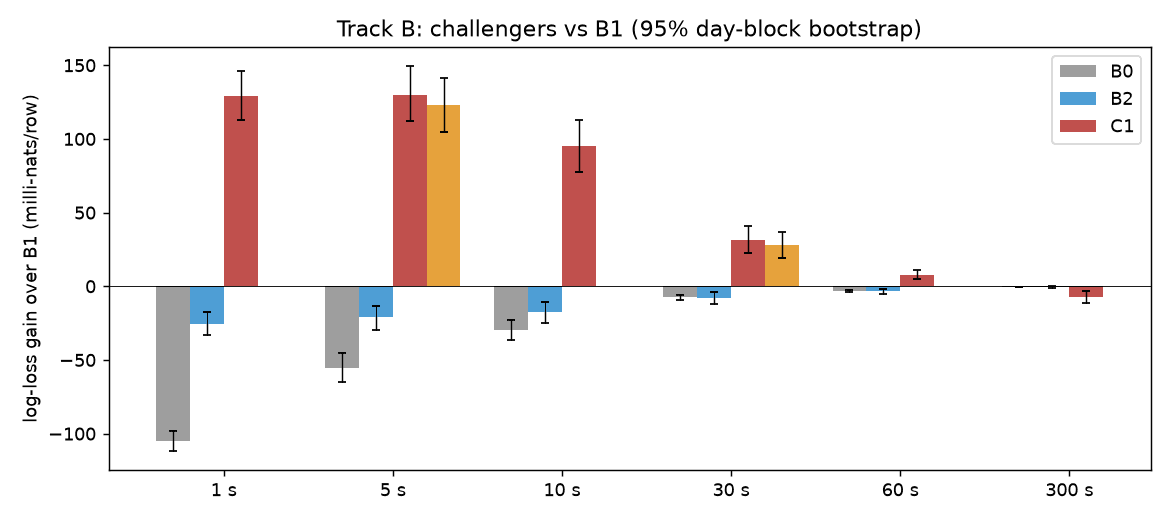
Gradient boosting gains about 130 milli-nats per row over the linear baseline at 1 s and 5 s; the gain is gone by 300 s. 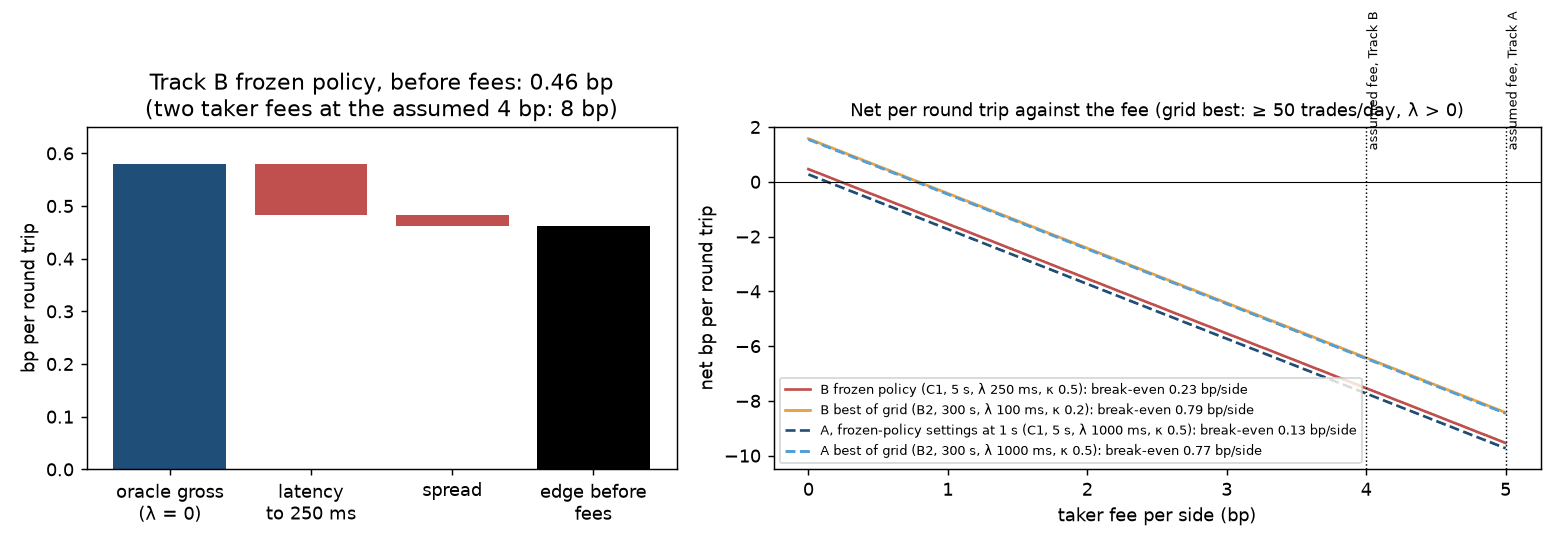
Edge before fees is 0.46 bp per round trip against 8 bp of fees; the frozen policy breaks even at 0.23 bp per side. 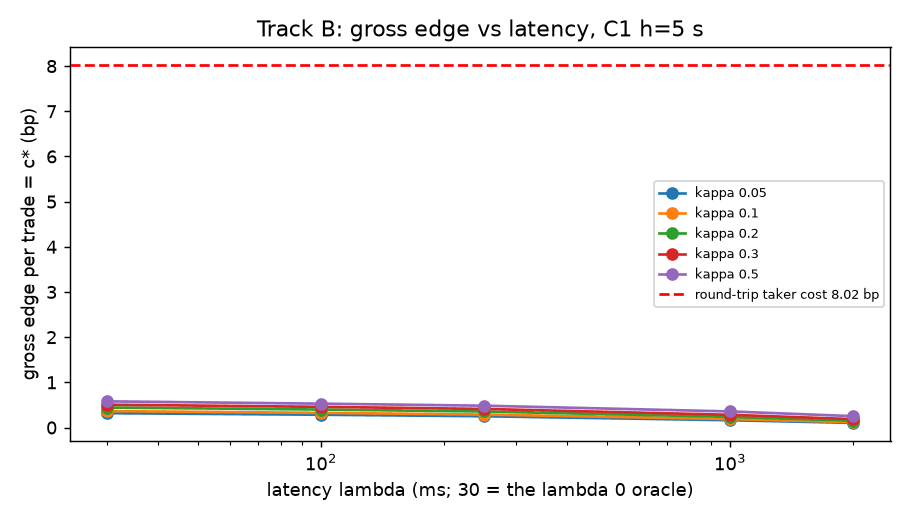
Gross edge stays below 1 bp at every latency, far under the 8.02 bp round-trip taker cost.
Data used
- Binance BTCUSDT perpetual top-of-book, trades and depth bands from data.binance.vision: 320 days, May 2023 to Mar 2024
- Coinbase BTC-USD order books and trades via Tardis.dev: 69 first-of-month days, Jan 2021 to Sep 2026
Built from HFT Quantitative Researcher job descriptions
The role asks for
- Short-horizon alpha signal research
- Machine learning and statistics
- Market microstructure and order books
- Low-latency and HFT trading
- Python and C++
- Production research and model monitoring
This project uses
- Order-flow imbalance and micro-price features
- Gradient boosting and CNN–LSTM forecasts
- Probability calibration and IC decay
- Latency and fee break-even analysis
- Queue-aware maker fill models
- Drift monitoring and model retirement
Members open the full write-up, notebook, tested code and data in the project reader.