Projects / Phase 4.3 · JD to Projects
Queue-Position and Latency-Aware Order-Book Simulator (C++)
Which passive-fill model and latency assumption should the research simulator certify for Coinbase BTC-USD, and which upstream claims (MM, EX, OB, OM) survive it?
Headline result
A C++ order-level book engine that scores 14 passive-fill models against exact queue position on 1.87 million virtual orders. The queue-back model had the lowest error (bias −0.08 pp, no false fills); the touch rule overstated fills by 7.5 pp and showed a joining maker losing USD 72 a session instead of USD 113.
Figures
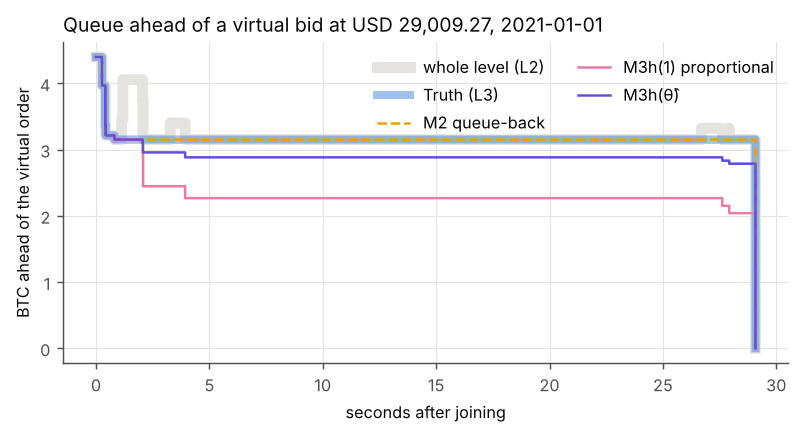
The queue-back fill model tracks exact (L3) queue position, while the proportional rule credits cancellations and moves the order forward too early. 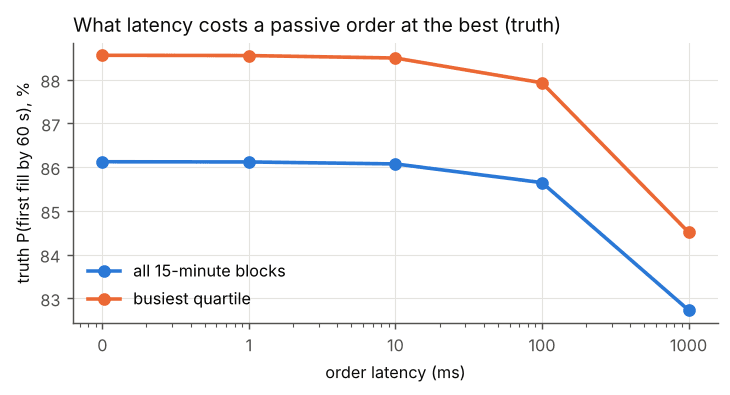
Latency costs little below 100 ms; at 1 s the fill probability drops from 86.1% to 82.7%, and 4.0 pp in the busiest quarter. 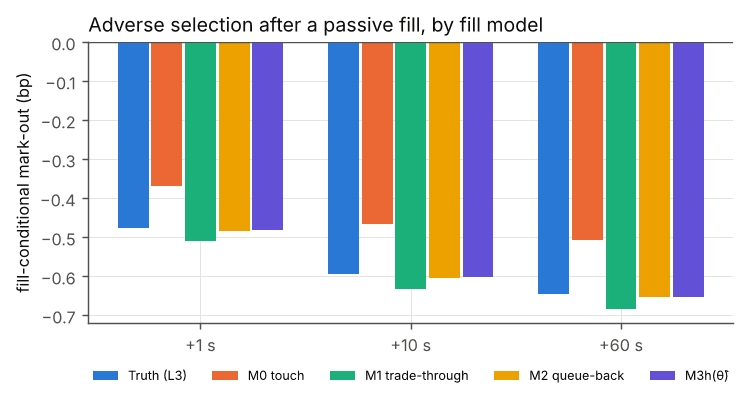
A real passive fill is followed by a 0.6 bp adverse move within 10 s; the touch rule makes fills look 22% less toxic. 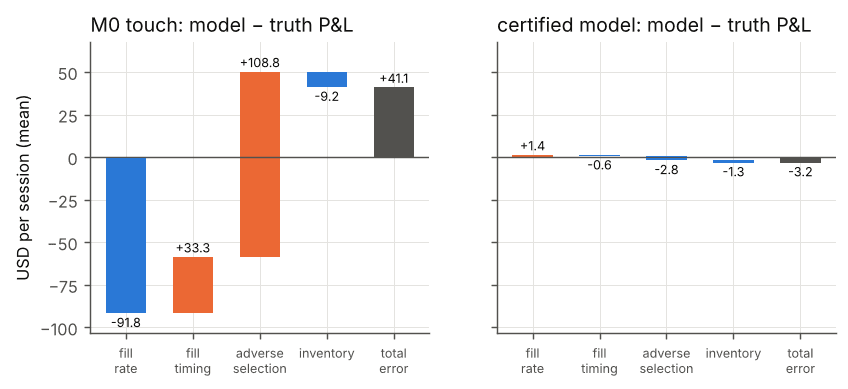
The touch rule’s large errors partly cancel to USD 41 per session; the queue-back model is off by only USD 3.2.
Data used
- Coinbase BTC-USD order-level feed via Tardis.dev: 24 six-hour sessions, 265m events, Jan 2021 to Sep 2026
- Coinbase BTC-USD L2 books via Tardis.dev as an independent check: 69 first-of-month sessions, Jan 2021 to Sep 2026
Built from HFT Quant Developer job descriptions
The role asks for
- Low-latency C++ engineering
- Market microstructure knowledge
- Exchange simulation and backtesting
- Fill and execution modelling
- Python and statistics
- Owning production research tools
This project uses
- Order-level (L3) book engine in C++
- Exact queue-position reconstruction
- Scoring 14 fill models against truth
- Latency and mark-out analysis
- Market-maker P&L error decomposition
- Deterministic, allocation-free hot path
Members open the full write-up, notebook, tested code and data in the project reader.