Projects / Phase 4.3 · JD to Projects
Intraday Cross-Sectional Statistical Arbitrage: From Signal to Monetised P&L
Do intraday cross-sectional signals survive costs, and how much does a cost-aware optimiser add?
Headline result
A 5-minute cross-sectional book on Binance perpetuals and S&P 500 stocks. The crypto signal is real (30-minute rank IC 0.027, positive in all 33 test months) but worth about 1 bp against 5–6 bp per trade. Rank-and-trade was ruined within weeks to months; the cost-aware optimiser traded 93–96% less and still lost 57–58% of capital.
Figures
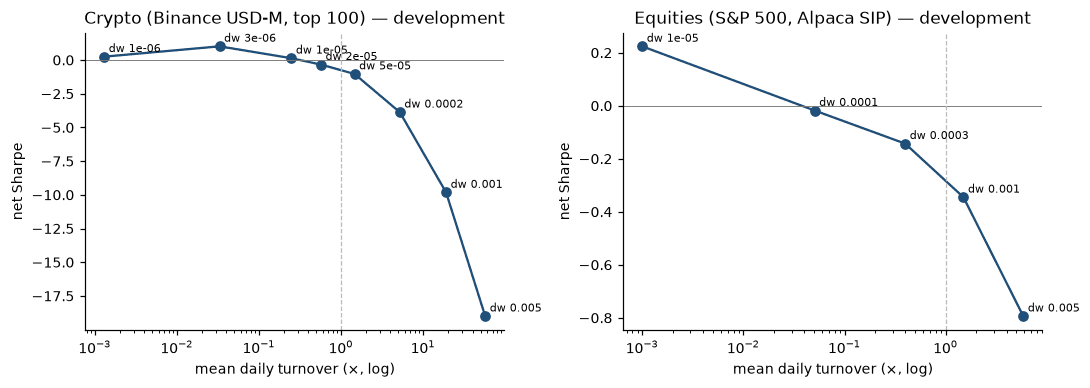
In development, net Sharpe rises as the book trades less and crosses zero only when the book barely trades. 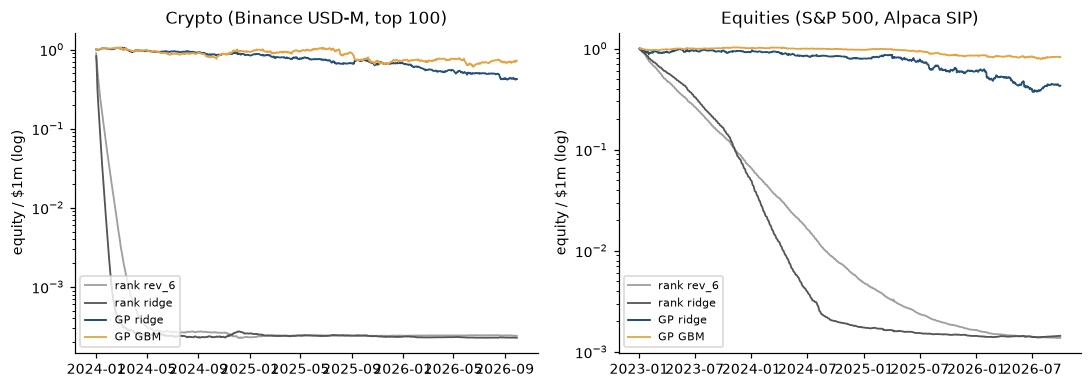
Rank books fell below 10% of capital within three weeks in crypto and ten months in equities; the ridge optimiser books ended near 42–43%. 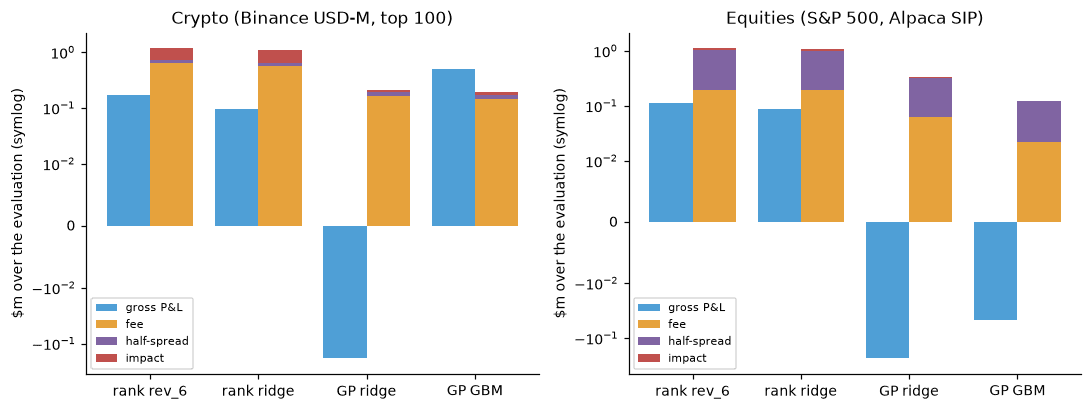
Costs swamp gross P&L in every rank book: crypto fees alone took 63% of capital against a 17% gross gain. 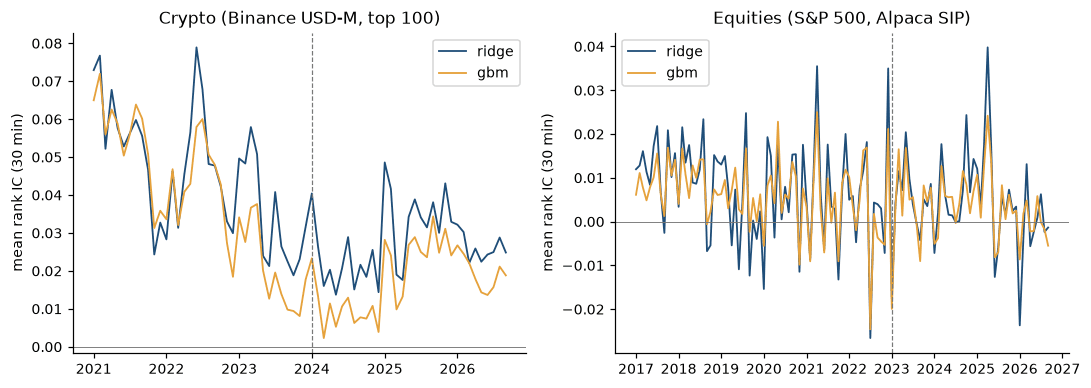
Crypto IC stayed positive every month; in evaluation ridge averaged 0.027 and gradient boosting a lower 0.018.
Data used
- Binance USD-M perpetuals 1-minute bars and funding from data.binance.vision: 900 symbols, Jan 2020 to Sep 2026
- S&P 500 members’ 5-minute bars from Alpaca’s SIP feed: 723 tickers, Jan 2016 to Sep 2026
Built from Mid-Frequency Quant Researcher job descriptions
The role asks for
- Intraday alpha signal research
- Transaction-cost and execution modelling
- Portfolio construction and optimisation
- Machine learning and statistics
- Python and C++
- Owning strategies in production
This project uses
- Ridge and gradient-boosted return forecasts
- Rank IC and signal-decay analysis
- Square-root market-impact cost model
- Gârleanu–Pedersen cost-aware optimiser
- Capacity analysis from $0.1m to $200m
- Point-in-time universe construction
Members open the full write-up, notebook, tested code and data in the project reader.