Projects / Phase 4.3 · JD to Projects
Grid Battery Valuation, Dispatch and Hedging
What is the battery worth, how should it be dispatched and hedged, should it be tolled?
Headline result
Dispatch, hedging and valuation of a 100 MW / 200 MWh battery at ERCOT’s North hub, 2019 to 2026. Its ten-year value fell from a $126.1M peak (Sep 2023) to $13.6M as ancillary prices collapsed. Degradation-aware dispatch cut cycling 63%, giving up $0.5M of revenue to avoid $3.45M of wear.
Figures
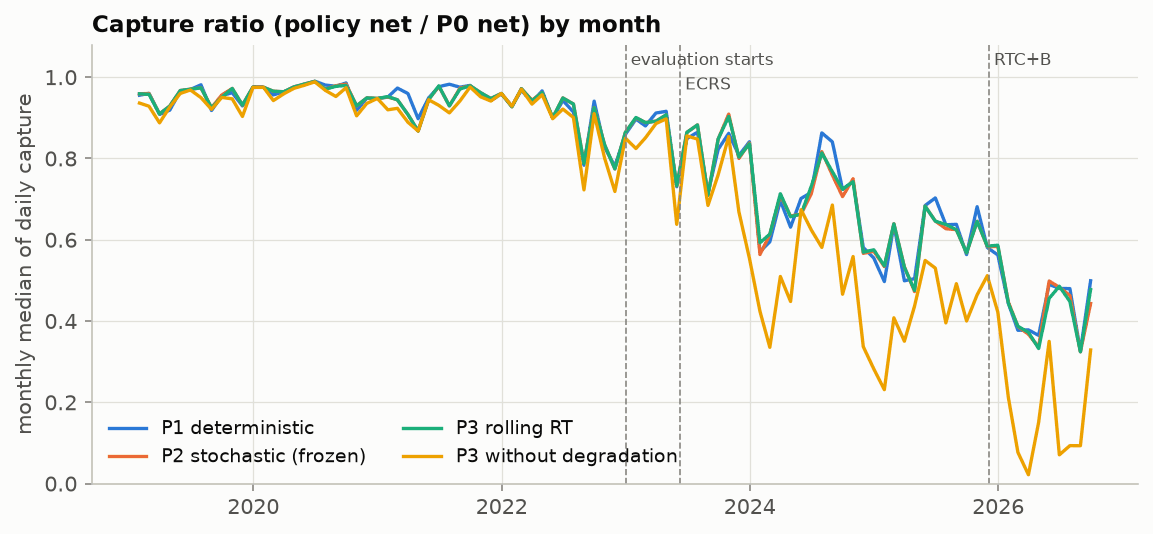
Capture fell from about 0.95 in development to 0.65 in evaluation; dispatch that ignores degradation falls furthest after ERCOT’s RTC+B market redesign. 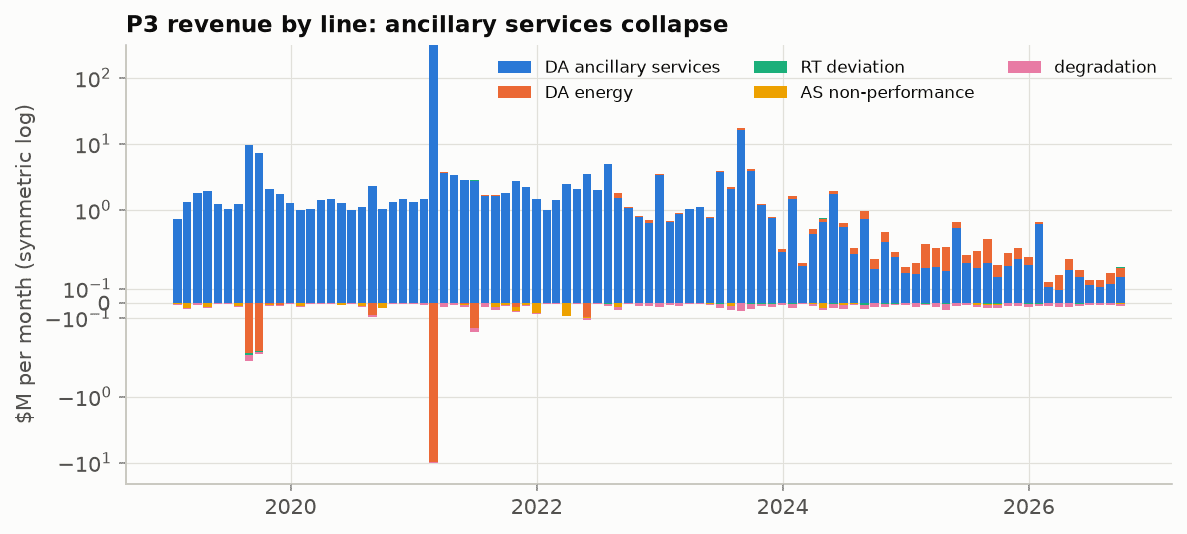
Ancillary services were nearly all revenue before 2023 and shrank after; merchant revenue fell from $344/kW in 2023 to $21/kW in Jan–Sep 2026. 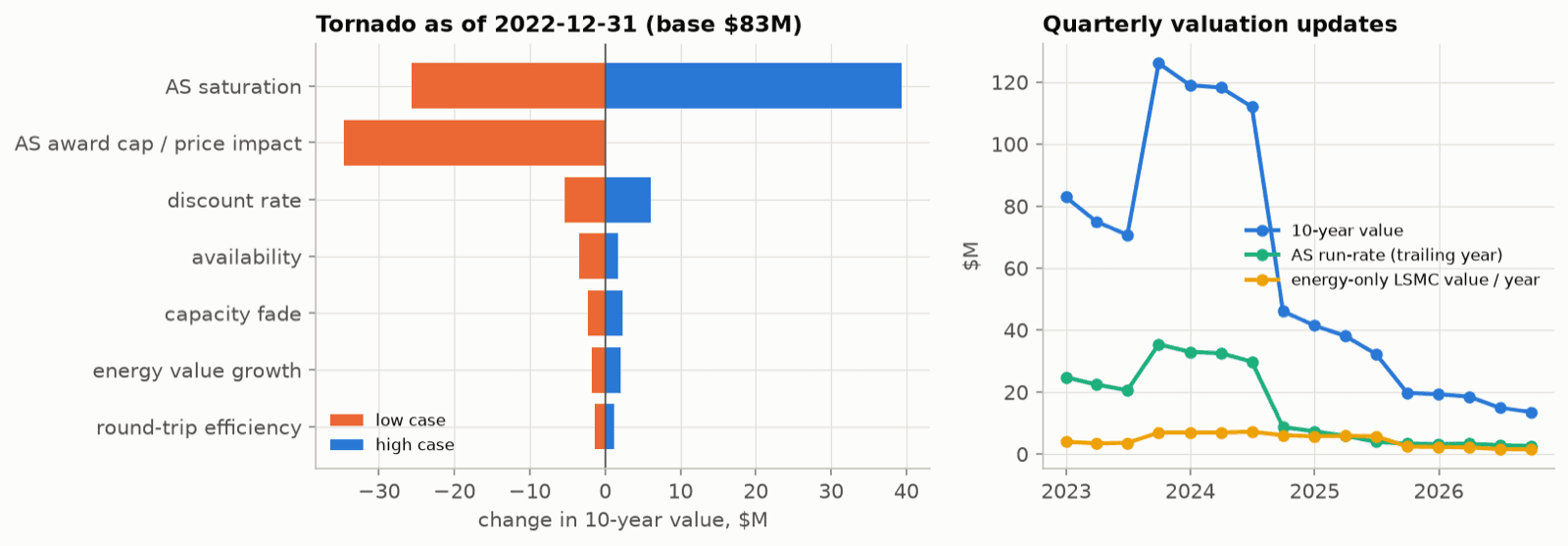
Ancillary-service saturation dwarfs every other driver; the ten-year value rose from $82.9M to $126.1M, then fell to $13.6M by Sep 2026. 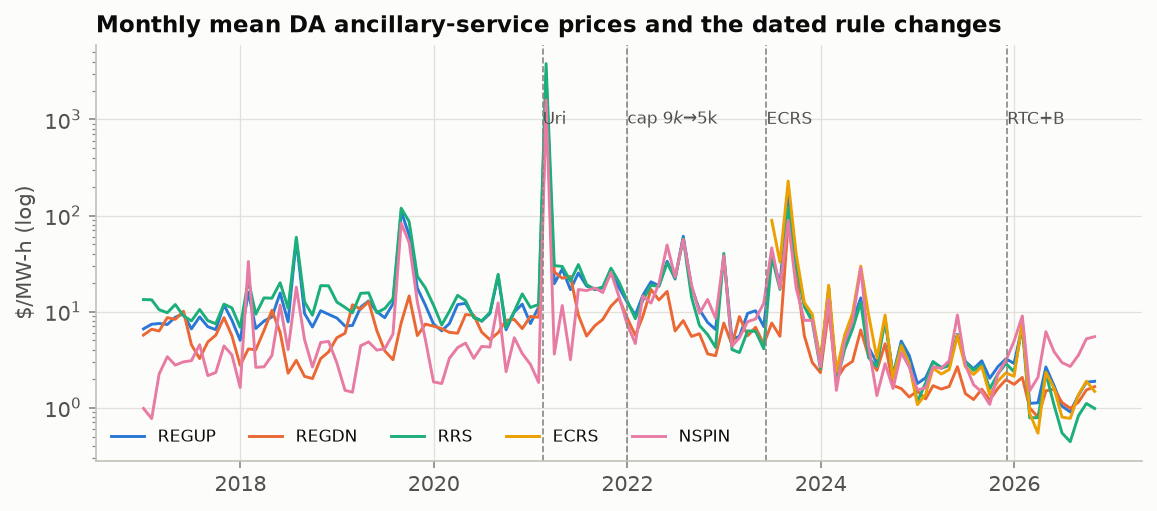
Regulation-up and responsive reserve averaged about $18–21/MW-h in 2019 to 2022 outside Winter Storm Uri, and $1.5–2.2 after the RTC+B redesign.
Data used
- ERCOT HB_NORTH day-ahead, real-time and ancillary-service prices via Grid Status, Jun 2016 to Oct 2026
- EIA-930 ERCOT load, wind and solar, Jul 2018 to Oct 2026
- Henry Hub daily spot via FRED and EIA, 1997 to Oct 2026
Built from Energy Quantitative Analyst job descriptions
The role asks for
- Energy asset valuation
- Dispatch and bidding optimisation
- Power price forecasting
- Hedging, tolling and revenue risk
- Python, SQL and statistics
- Clear communication with commercial teams
This project uses
- LEAR day-ahead price forecasting
- LP dispatch with degradation cost
- Stochastic planning with a CVaR penalty
- Least-squares Monte Carlo valuation
- Revenue-at-risk backtesting
- Toll and revenue-floor pricing
Members open the full write-up, notebook, tested code and data in the project reader.