How quant firms trade differently—and what that means for your 2027 roadmap
Two people can both work in quantitative finance while solving very different problems. One updates prices for an options book. Another tests a signal across a stock universe. A third helps an investment team understand an economic release.
The difference often begins with the business. Who supplies the capital? What service or investment result is the team trying to deliver? How does information become a position, and how is that position managed?
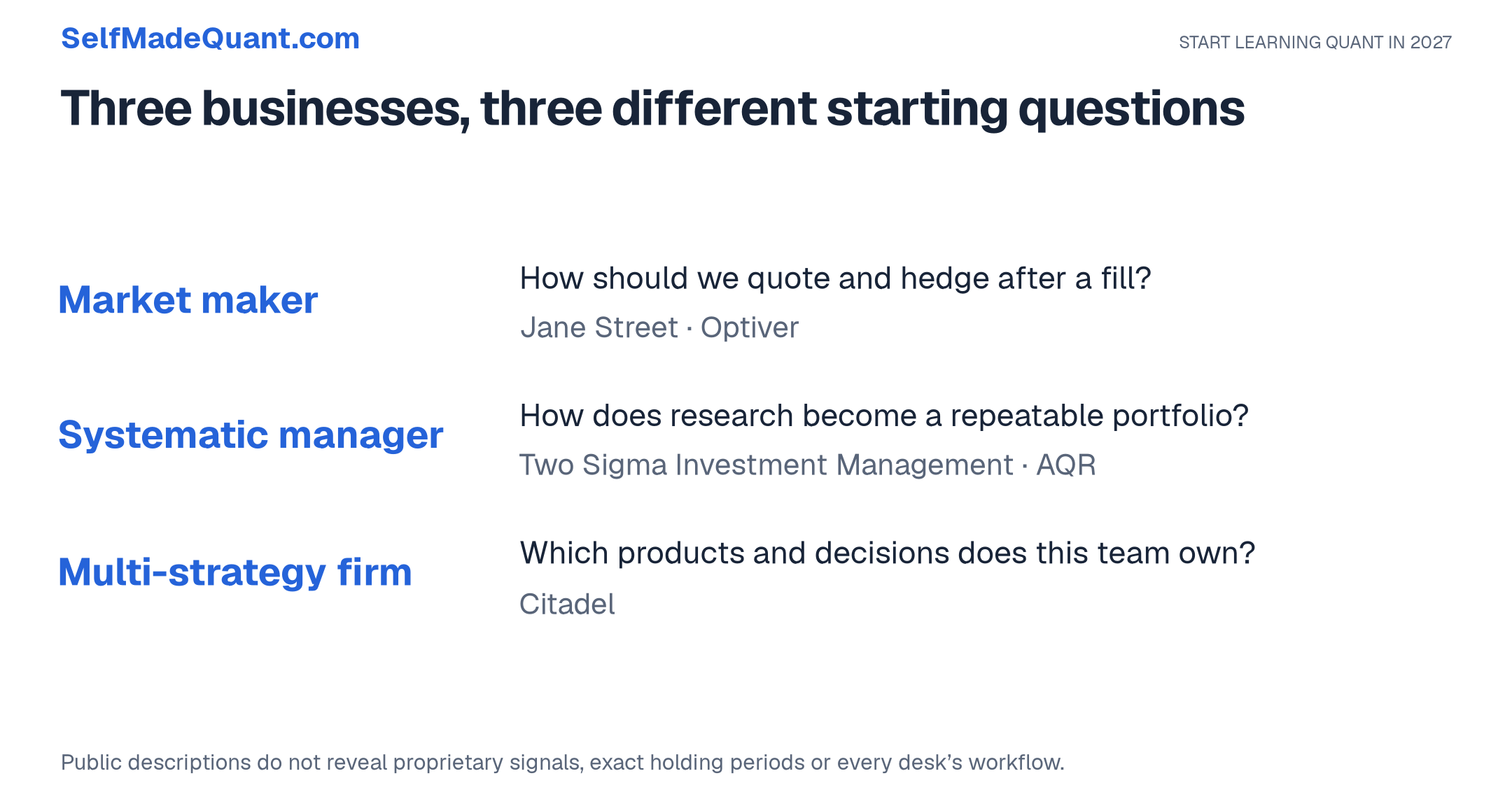
Public firm descriptions help answer those questions at a broad level. They do not reveal proprietary signals, exact holding periods or every desk's workflow. The examples here use those descriptions to build a learning map, not a ranking of employers or a forecast of their 2027 strategies.
Market makers: price liquidity and manage the resulting risk
A market maker offers prices at which it will buy and sell. A fill changes its inventory. The challenge is to keep prices useful while managing information risk, hedging, costs and exposure.
For a beginner, ask: what happens after my quote trades? A quoted spread is not guaranteed profit. The market may move, the counterparty may be better informed, and hedging or fees can change the result.
Study Probability, Statistics and Financial Data with Market Microstructure and Execution. Add Derivatives Pricing and Computational Finance if options interest you. Start with Order Book Slippage, then explore Inventory-Aware Market-Making Research.
Systematic investment managers: turn research into portfolios
A systematic investment process converts research into repeatable rules for forecasts, positions and risk. Data quality, validation, portfolio construction and execution all matter. Systematic does not specify one holding period, asset class or modelling technique.
These firms should not be reduced to “machine learning” versus “factors.” Their public categories are broader than that, and methods can overlap. Your first exercise can stay simple: compare one transparent forecast or allocation rule with a baseline using the same available information.
Study Econometrics and Financial Time Series, Quantitative Research, Data and Backtesting, Portfolio Theory and Quantitative Investment, and Empirical Asset Pricing and Factor Investing. Add Financial Machine Learning when it answers a defined research question. Pair the Strategy Backtester with Portfolio Risk Forecasting and Rebalancing Control.
Multi-strategy investment firms: the team matters as much as the name
A research question supporting a macro investment can differ from one supporting a systematic equity strategy. One might focus on economic data releases and revisions; another on a cross-sectional signal, portfolio constraints or execution. These are illustrative task examples, not claims about an unpublished Citadel strategy.
If macro work interests you, combine Fixed Income and Interest-Rate Models with econometrics and Macroeconomic Forecasting with Historical Data Vintages. If systematic equities interests you, begin with backtesting and portfolio construction. The firm name alone cannot choose between those paths.
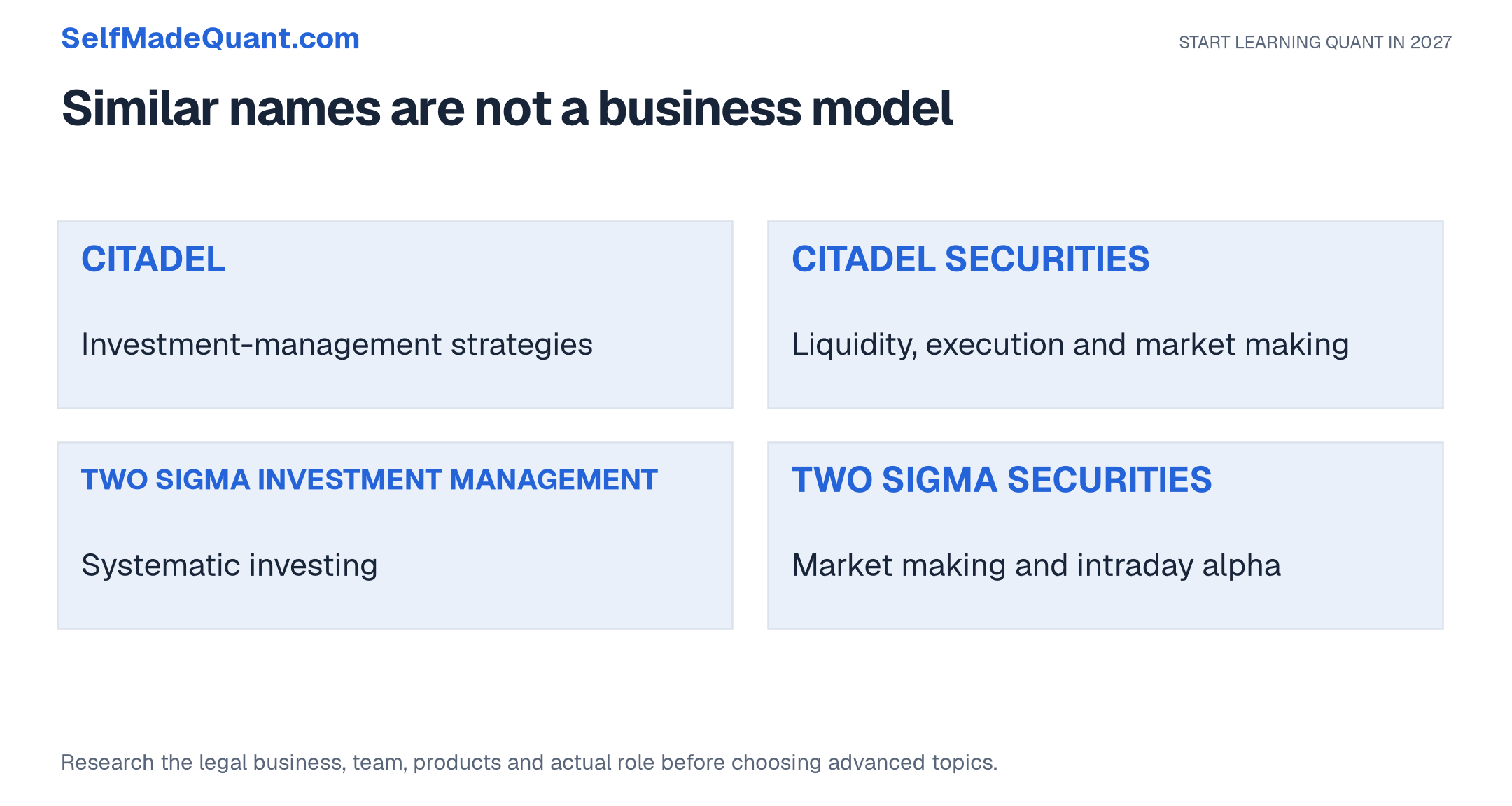
Similar names can hide different businesses
For any application, identify the legal business, team, asset class and role. Then ask which part of the process you would actually own: research, pricing, execution, risk or software.
Bank trading and quant teams: begin with the mandate
A bank role can involve client pricing, hedging, model development, risk or independent validation. Treat that as a broad set of functions to investigate rather than a single trading style. A derivatives desk's needs can differ greatly from a validation team's needs even inside the same institution.
Here the learning question is practical: are you preparing to price a contract, explain a hedge, measure exposure or challenge a model? Derivatives, fixed income, counterparty credit and Professional Quant Practice offer different routes into those tasks. Ask the actual job description which route applies.
Choose the learning path after the business question
Use four prompts when researching a firm: what does this business deliver, which products does the team work with, what decisions would I support, and what evidence would make my work useful?
Then keep the first steps approachable. Start with Python, probability and financial instruments. Build one small project. C++ can be an optional later topic if a particular engineering specialism attracts you; it does not need to block your first quant study session.
Go deeper with lessons, derivations and worked exercises behind this article.